Puglia Tap Water: What You Need to Know
Find out whether you can drink tap water, how public drinking fountains work and what to budget for water in restaurants.
It is the question that comes up as you put down your bags in a Lecce Airbnb or an Itria Valley trullo, thirsty after the journey: can I pour myself a big glass of tap water, or do I need to head straight to the supermarket for bottled water?
Is tap water safe to drink in Puglia?
Tap water supplied through Puglia's public network undergoes health checks in line with European standards. Follow any local non-potability notice, and ask your host if you are unsure whether the property's supply is confirmed as safe to drink.
This modern convenience owes much to a vast infrastructure completed in the early 20th century: the Acquedotto Pugliese (AQP). Water is collected in the mountains of neighbouring Campania, at the Caposele springs, crosses the Apennines and supplies the entire heel of Italy. It is tested at every stage of its journey.
If you are staying in Bari, Brindisi, Lecce, Monopoli or Gallipoli's old town, ask your host if you are unsure about the water at your property. The public network is monitored, but the building's pipes and storage system also matter, as do any local non-potability notices.
Why does tap water taste of chlorine, and what can you do about it?
Public drinking water meets health standards. Taste is another matter, and that difference often sends travellers to the supermarket after their first sip.
Puglia's limestone landscapes, including the Murge plateau, help explain the mineral taste of some local water. Hardness and taste vary with the supply and the building. Limescale marks around a sink do not, by themselves, show whether water is safe to drink.
There is also the chemical treatment needed to keep it safe. The network uses chlorine to protect the water during its long journey through pipes in intense summer heat. In August, the smell and taste can be particularly noticeable when you turn on the tap.
Chilling drinking water in a clean jug can make its taste more pleasant. A suitable filter may reduce chlorine taste, but its performance depends on the cartridge: activated carbon alone does not remove limescale, and an ordinary taste filter does not make unsafe water safe. Follow the manufacturer's cleaning and replacement instructions, and use only water confirmed as suitable for drinking.
Fontanelle: Puglia's free public drinking fountains
© Sciking / Wikimedia Commons — CC BY-SA 3.0
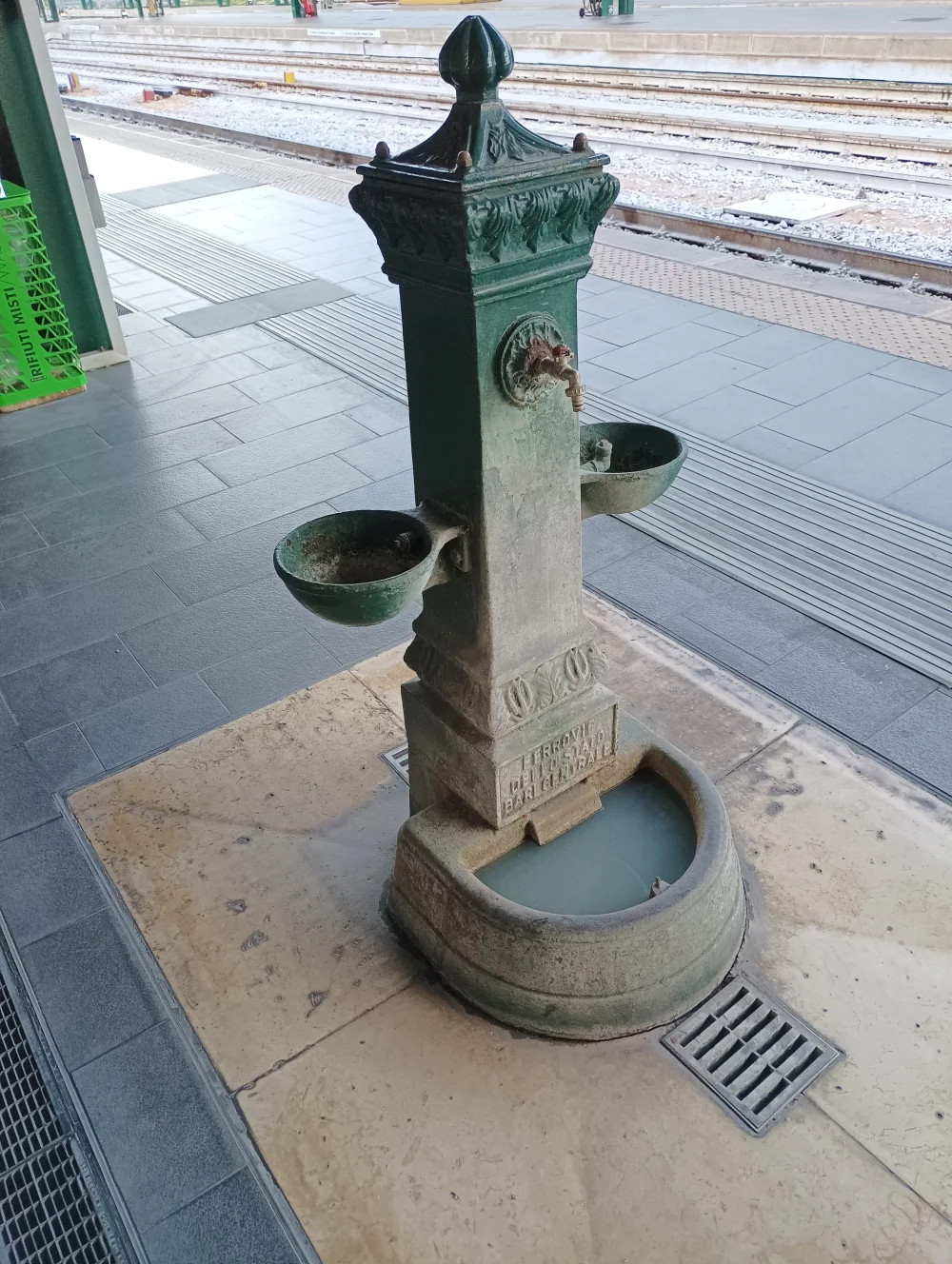
As you wander through old town centres, you will come across little green cast-iron fountains. Standing on paved squares, against church walls or beneath pine trees in public parks, they are known locally as cape de firr, ‘iron heads’ in Bari dialect, a name inspired by their distinctive little metal caps.
These fontanelle are symbols of the Acquedotto Pugliese and provide free public drinking water, normally available day and night. In summer, their water is often cooler than domestic tap water because the public supply pipes run deep underground. Check any signs or local notices before filling your bottle.
Look closely at the spout: there is always a small hole on top. It is not a flaw in the casting. Cover the main outlet with your thumb or palm and water shoots out through the upper hole in an arc, so you can drink directly without getting soaked. Watch an Italian child after school: they make it look effortless.
Water in Italian restaurants: a different custom
If you are used to free tap water in restaurants, Italy can come as a surprise. In France, asking for a jug of water in a bistro is almost a right. In Italy, you need to set that expectation aside.
A free jug of tap water (acqua di rubinetto or acqua della casa) is not part of Italian restaurant culture. Ask for one and the waiter may look puzzled or politely explain that they serve only sealed bottles. This is not a trick to inflate tourists' bills: Italians drink enormous quantities of mineral water with meals.
Once you sit down, often before you have even seen the menu, the first question will be the same: ‘Acqua naturale o frizzante?’ You order a chilled glass bottle of still or sparkling water, such as Lete, Ferrarelle or San Benedetto, at €1.50–3 per litre. More and more restaurants also offer acqua microfiltrata, mains water filtered on the premises and served in a reusable glass bottle bearing the restaurant's name.
- Bottled mineral water: €1.50–3 per litre, ordered and charged separately
- Coperto: a fixed €2–4 per person covering bread, table linen and tableware; water is never included
- Acqua microfiltrata: water filtered on the premises and served in a reusable glass bottle, an increasingly common option
Remote trulli and masserie: check the water tank
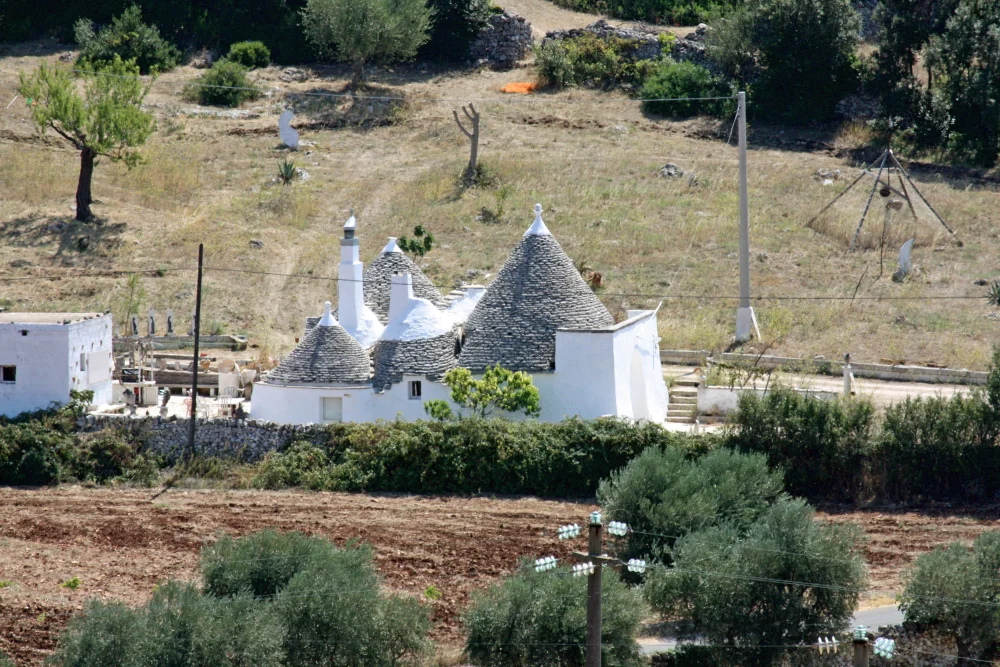
Town centres are fully connected to the public network, but Puglia is still a deeply rural region. Rent a conical-roofed trullo in the Itria Valley, or a fortified 17th-century masseria tucked away in the countryside around Fasano or Ostuni, and the practicalities change considerably.
An isolated property may use a storage tank, or cisterna, rather than a direct mains connection. Traditional trulli also collected rainwater in underground cisterns, and some properties use tanker deliveries, known as autobotti. Ask your host which system supplies the taps and whether the water is confirmed as safe to drink; the type of accommodation alone does not answer that question.
A storage tank does not automatically make water unsafe. Its suitability for drinking depends on the water supplied, the installation and its maintenance. Ask the host to confirm potability. If it is unconfirmed or the water is marked non-potable, use a confirmed drinking-water supply for drinking and food preparation, and follow any local restrictions.
© Carlo Pelagalli / Wikimedia Commons — CC BY-SA 3.0
Before booking rural accommodation on Booking.com, ask the host: “L'acqua del rubinetto è potabile?” — is the tap water safe to drink? If they cannot confirm it, plan another drinking-water supply. A five-litre container costs around €1.20–€1.80 at supermarkets such as Conad, Eurospin or Famila, although prices vary. Treat 15–20 litres for two people as a shopping estimate, not a fixed weekly allowance, especially in hot weather. Heavy supplies are easier to carry by car. For your route through the region, see our five-day Puglia itinerary.
Water in Puglia: four things to remember
Mains water is regularly tested, but check local notices and the supply at your property. Chilling confirmed drinking water in a clean jug can improve its taste.
Look for the cast-iron drinking fountains known as cape de firr, and check any signs before filling your bottle. Use fountains identified as drinking-water sources; a decorative fountain or an unmarked outlet is not automatically suitable.
Expect to order and pay for a glass bottle of still or sparkling mineral water, costing €1.50–3, rather than receive a free jug of tap water.
Ask the owner whether the tap water is confirmed as safe to drink, including when it comes through a storage tank. If potability is unconfirmed, arrange another drinking-water supply for drinking and cooking.
Frequently asked questions: drinking water in Puglia
Can you drink tap water in southern Italy and Puglia?
Do you have to pay for water in Italian restaurants?
How can you remove the chlorine taste from tap water?
Do you need bottled water for coffee or cooking pasta in Puglia?
Is the water in showers on Puglia's public beaches safe to drink?
What is the Acquedotto Pugliese?
Famous for conical roofs born from a tax dodge, Alberobello is Puglia's most striking stop. Find out how to avoid…
Read more →A little planning helps keep costs down in southern Italy, especially around private beaches. Here are my ten favourite free…
Read more →Baroque Lecce: guided walk and underground rooms