Ostuni
La Città Bianca (The White City)
Perched on three hills above a sea of olive trees, the Città Bianca is a white maze made for wandering. Find your way around this Puglian town and enjoy its best corners without falling into the tourist traps.
In Ostuni, I would allow half a day for the white lanes and ramparts, or a full day to add the museum and stay for dinner. Here is my walking route, with the sights to prioritise and tips for arriving, parking and exploring the surrounding area.
What to do in Ostuni: the highlights
Piazza della Libertà, the lanes of Rione Terra, the cathedral and the ramparts form the heart of an Ostuni visit. I would allow half a day for a first look, or a full day to add a museum, lunch and the pleasure of seeing the façades light up in the evening.
From the road, the Città Bianca rises above a carpet of olive trees. Once you are in its streets, the details take over: a blue door, a shady archway, a few steps revealing the distant sea. In summer, I would walk here in the morning or late afternoon, away from the full force of the heat reflected by the walls.
© Benjamin Smith / Wikimedia Commons — CC BY-SA 4.0
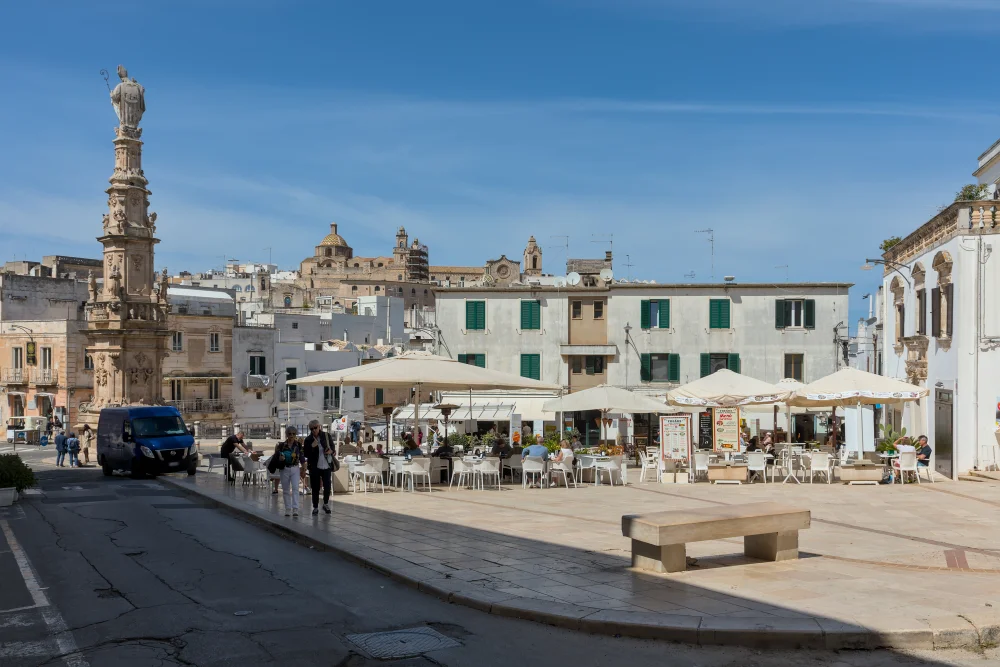
Piazza della Libertà and Sant'Oronzo
Piazza della Libertà marks the meeting point between the modern town and the old centre. At the foot of Sant'Oronzo's obelisk, watch the café terraces being set up before starting the climb. It is the easiest place to get your bearings in Ostuni.
© Ingo Kuebler / Wikimedia Commons — CC BY-SA 3.0
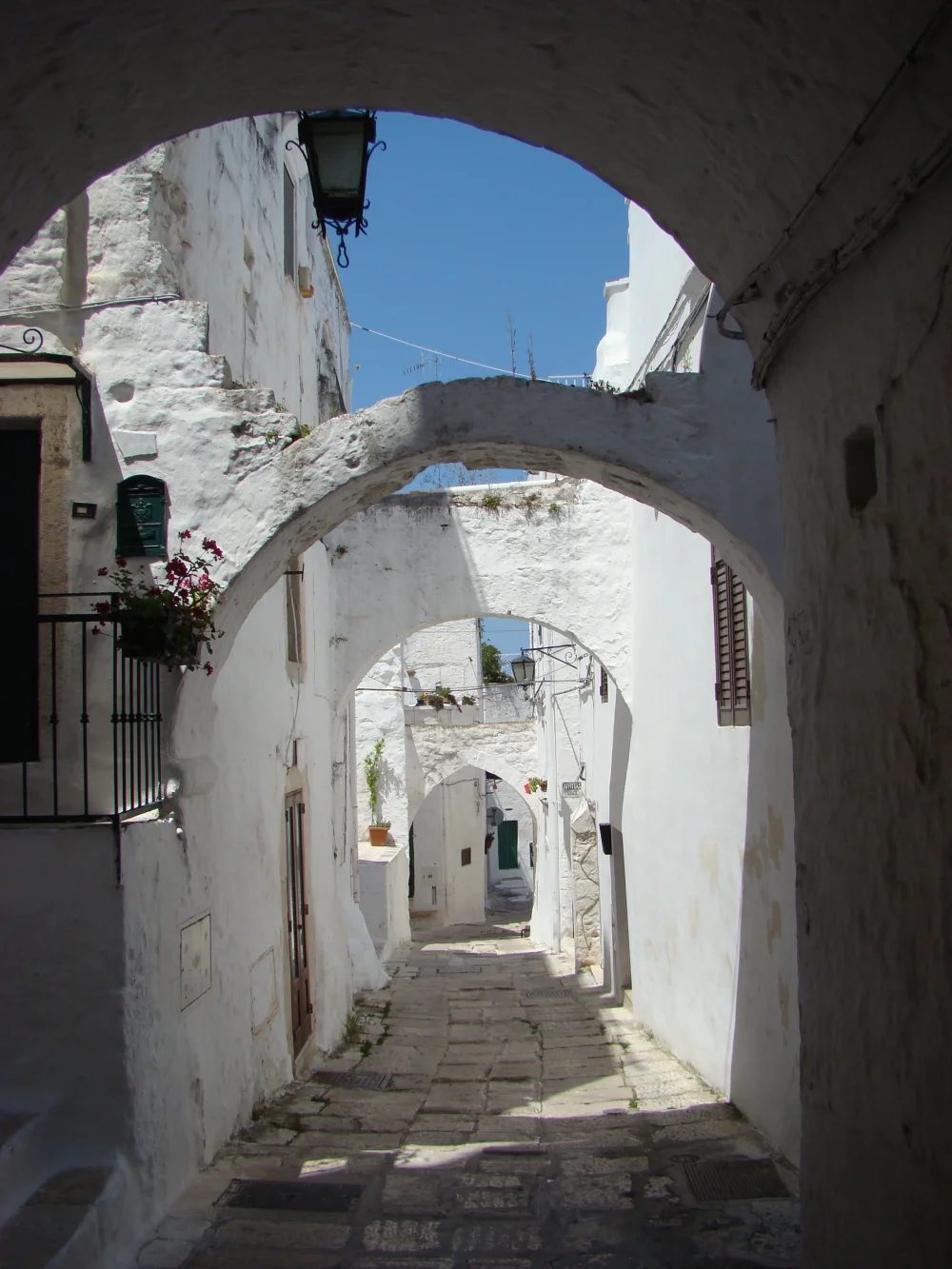
Rione Terra, Ostuni's white heart
Narrow arches, steps and shady passages leading into bright little squares: step off Via Cattedrale now and then to explore the old town. White façades set off turquoise doors, green shutters and plants arranged on the steps.
© Cavaliere grande / Wikimedia Commons — CC BY-SA 3.0
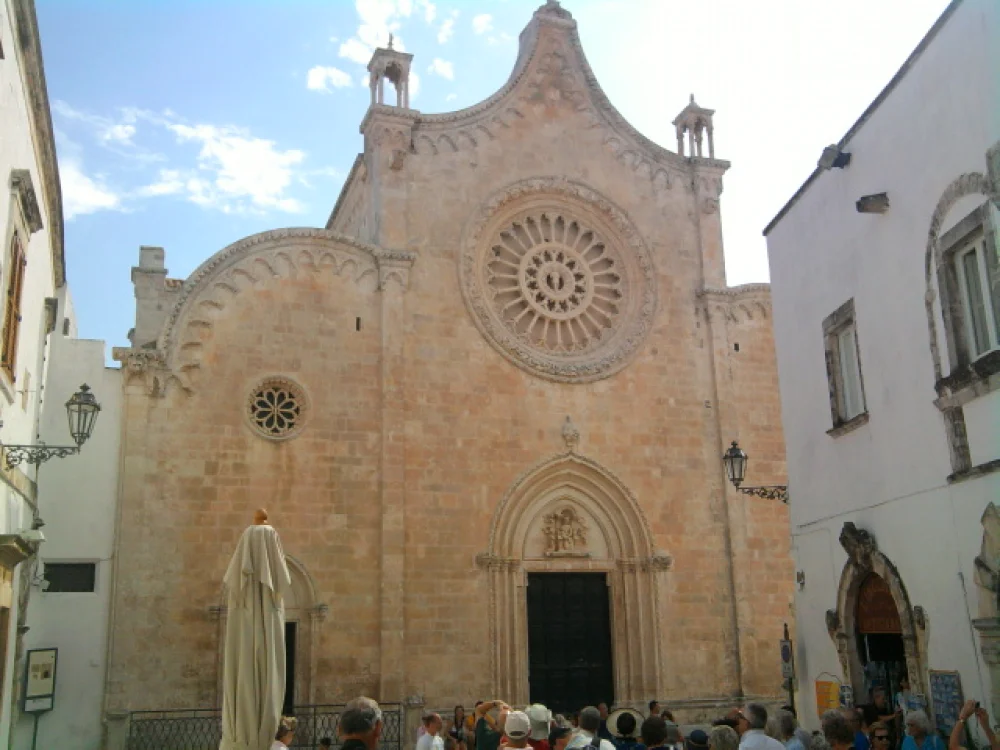
Santa Maria Assunta Cathedral
The cathedral's ochre façade stands out against the whitewashed houses. Its large carved rose window immediately draws the eye. Take time to study it from the small square, then step inside if visiting hours and services allow.
© Benjamin Smith / Wikimedia Commons — CC BY-SA 4.0
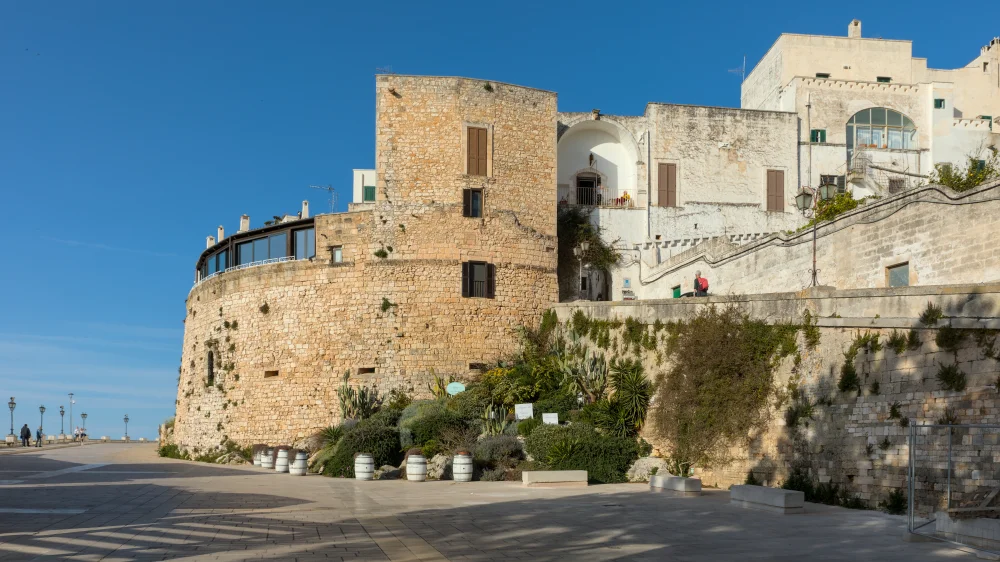
Porta San Demetrio and the ramparts
At the ramparts and Viale Oronzo Quaranta, views open out over olive groves and the Adriatic. After the narrow lanes, you can finally see how the town sits above the plain.
The Touring Club Italiano lists free admission to the cathedral. Check opening times on arrival, as they vary with the season and services.
The Museum of Pre-Classical Civilisations: beyond the façades
The Museo di Civiltà Preclassiche della Murgia Meridionale, at 15 Via Cattedrale, adds another dimension to a visit. Its displays include the ‘Donna di Ostuni’, a prehistoric burial discovered at Santa Maria di Agnano. This is the indoor visit I would add to see more of Ostuni than its white lanes.
Adult admission is listed at €5, with 60–90 minutes suggested for a visit. The museum publishes opening hours of 10am–2pm and 4–7pm on weekdays, and 10am–7pm at weekends. Check its visitor information for your date. The cathedral and museum have separate admission arrangements.
How long do you need in Ostuni?
- 3–4 hours: the old town, the cathedral if open and the rampart walk, with a few breaks.
- A full day: add the museum, lunch and an evening in town, without rushing between sights.
- Two days: spend the second in the olive groves, at a beach or visiting nearby villages. You do not need two days just to see Ostuni.
The centre is compact but hilly. A short distance on the map says little about the steps, photo stops and heat. Time for sightseeing and the number of nights are two different questions: staying several nights is mainly worthwhile if you plan to explore the surrounding area.
One day in Ostuni: our walking itinerary
This is the route I would follow from Piazza della Libertà. The times are a guide, not fixed appointments. If you have only half a day, keep the first four stops. An afternoon museum visit and an evening in town let you stay longer without leaving Ostuni.
Lanes, ramparts and an evening in the White City
Start at the foot of Sant'Oronzo's obelisk. Have a coffee and a pasticciotto before the climb.
Pasticciotto: around €3Walk up towards the old centre, then take a detour into the lanes. Allow a little time for passages and small squares rather than sticking to the main street.
Explore at your own paceStudy the rose window and the nearby stone passage. Going inside depends on opening hours and services, so adjust the order if necessary.
Cathedral: free admission listedEnjoy the views across the plain to the Adriatic, then walk back down towards the café terraces. This makes a good end to a half-day visit.
Views over the olive grovesChoose a puccia for a quick lunch or an osteria table if you want to linger. In summer, wait until the hottest part of the day has passed before tackling more hills.
Puccia: around €8–12Return to Via Cattedrale for the Museum of Pre-Classical Civilisations. Round off the walk with shops and a few streets you have yet to explore.
Museum: €5 full-price admissionReturn to the viewpoints as the light fades, then stay for dinner. Sunset falls at different times throughout the year, so check the time for your month.
Optional eveningOstuni at night: viewpoints, aperitivo and illuminated lanes
I would happily set aside an evening for Ostuni. Return to the ramparts and Viale Oronzo Quaranta as the light fades, then wander back into the little streets. The olive groves darken, café terraces fill up and the lighting gives the whitewash a softer glow.
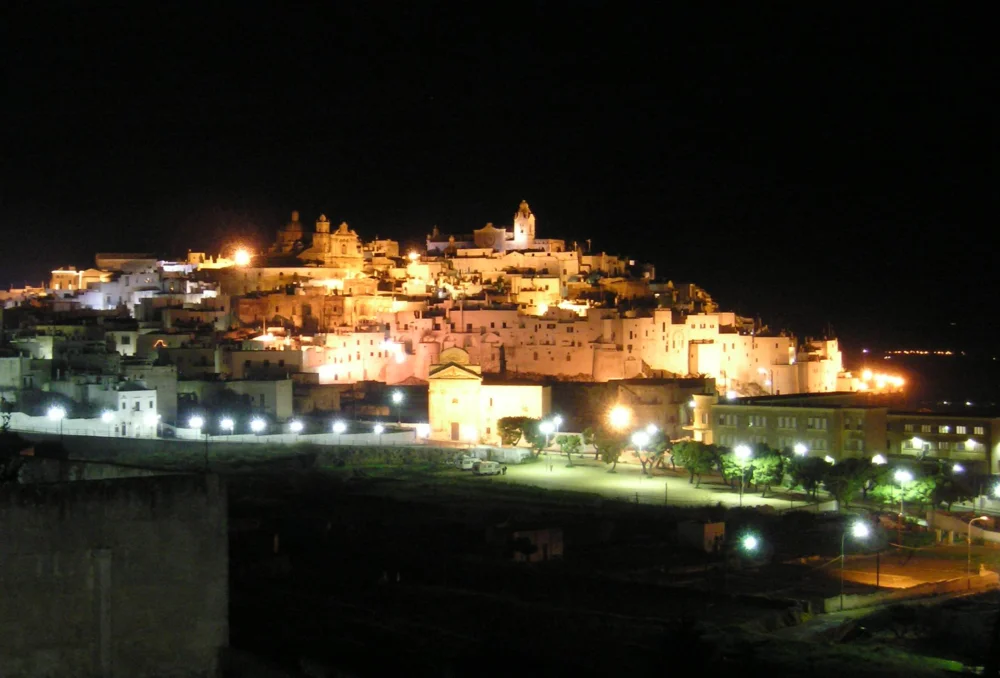
Ostuni at night, Puglia · © Riccardo Prudentino (Utente Wikiricky) / Wikimedia Commons — CC BY-SA 3.0
At Borgo Antico Bistrot, the aperitivo tables are set along the steps. Riccardo Caffè is another option in the centre if you want to stay out longer. In high season, do not count on finding an outdoor table straight away.
Do not let the whole evening depend on one particular table. A walk along the ramparts, dinner and a few illuminated lanes already make a lovely plan. Day-trippers are fewer, but Ostuni is not quiet everywhere: the bars take over.
How to get to Ostuni and where to park
You do not need a car to visit the old town. It makes some countryside excursions easier, but you can also reach Ostuni by train. The part to plan is getting from the station to the hilltop centre.
From Brindisi
By train
By car
Ostuni station to the centre: plan the bus connection
STP Brindisi publishes a service between Ostuni station and the centre. Check the best stop for your accommodation and the return to the station. If you stay for dinner, the last bus matters more than the train's arrival time alone.
Where should you park to visit Ostuni?
The car parks on Via Tenente Specchia and Parcheggio Stella, at 3 Contrada Santo Stefano, are two options near the old town. Check the displayed price, how long it covers and the remaining walk to your destination. I would not count on an included shuttle unless the car park confirms one.
For free parking, look further from the centre and check the signs: white-marked spaces may also have restrictions. In summer, I prefer paying for a clearly signed space to driving around for ages to save a few euros.
The centre has restricted traffic zones and pedestrian streets. Do not pass a prohibited entrance without the appropriate authorisation. The council offers several categories of ZTL permit, not only for residents. Your host should explain how to arrive, but a booking does not automatically authorise your vehicle.
With a pushchair or limited mobility, plan a route rather than choosing every little street at random. Slopes and steps make some detours difficult; for a young child, a baby carrier may be more practical. An Ape Calessino tour is an option on permitted roads, but check the route: it cannot reach every flight of steps.
Where to eat in Ostuni
After all the steps, lunch comes at the right moment. A puccia filled with capocollo and stracciatella, around €8–12, suits a day of walking. For a longer meal, vegetables, pulses and olive oil are at the heart of the local cooking.
Orecchiette alle cime di rapa
The little ear-shaped pasta catches the cime di rapa, garlic and olive oil, sometimes with anchovies. A classic to choose according to the menu and season.
Bombette pugliesi
Little pork rolls stuffed with cheese and grilled. To try a butcher's shop that cooks your chosen meat on the spot, include a stop in Cisternino too.
Fave e cicoria
Sweet broad bean purée meets bitter chicory. A drizzle of olive oil finishes this simple dish, firmly rooted in Puglian cooking.
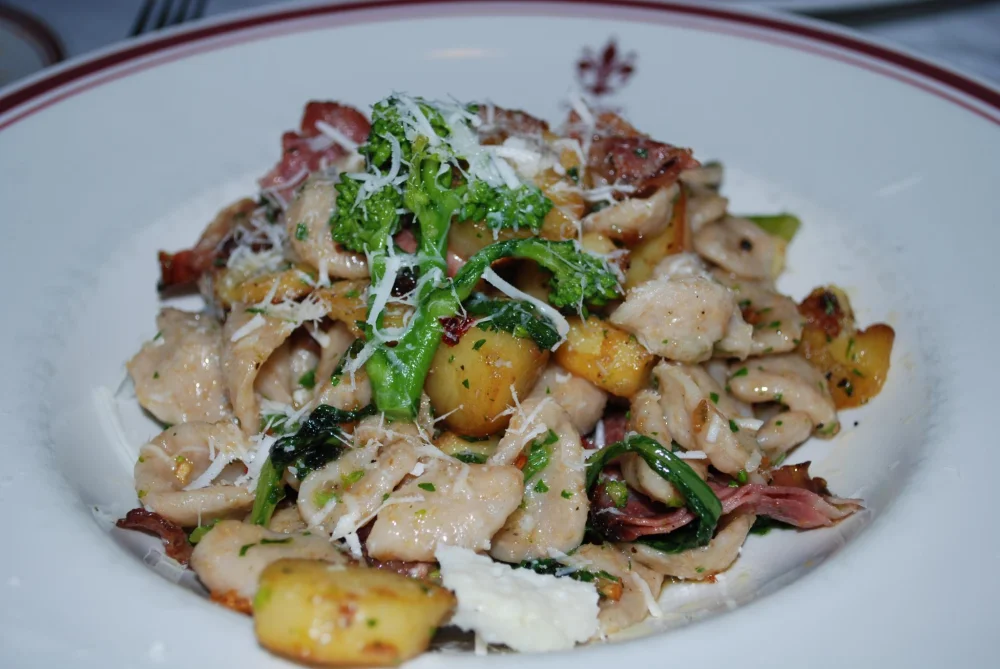
Orecchiette alle cime di rapa · © Alpha from Melbourne, Australia / Wikimedia Commons — CC BY-SA 2.0
The following budgets are approximate amounts per person, depending on the dishes and meal chosen. Drinks, the coperto cover charge and special menus can change the bill.
| Restaurant | Speciality | Indicative budget | Why eat here? |
|---|---|---|---|
| Osteria Monacelle | Traditional cooking | €15–25 | Pasta and local dishes in the centre. Worth considering for a straightforward meal. |
| Osteria del Tempo Perso | Seasonal market cooking | €20–40 | For the setting carved into the stone and Puglian recipes. Book if you are set on dinner here. |
| Osteria Ricanatti | Contemporary cooking, tasting menus | €80–120 | For a more elaborate interpretation of local produce, à la carte or as a tasting menu. Listed in the MICHELIN Guide. |
Where to stay in Ostuni
The centre for walking out in the evening; the countryside for a longer stay among olive trees. Both have their appeal. I would decide mainly according to whether you have a car and how many excursions you plan.
In the White City, ask about stairs and any help with luggage. At a masseria, check whether you can have dinner on site: a lovely remote room becomes less convenient if every meal means driving again.
| Accommodation | Budget / night | Our view | Booking |
|---|---|---|---|
| Palazzo AD 1892 · Suites & Spa | Around €55–120 | A restored palazzo for exploring Ostuni on foot. Check the facilities in your chosen suite and access with luggage. | Check availability → |
| Masseria Salinola | Around €120–200 | A family-friendly countryside option with a pool and farmland. Best with a car for exploring the surroundings. | Check availability → |
| La Sommità Relais & Châteaux | Around €200–500 | For an upmarket stay in an old-town palazzo. Compare rooms, views and the services included. | Check availability → |
These ranges give an idea of the cost of a room per night, rather than a guaranteed price for your dates. For more choice, compare masserie around Ostuni on Booking.com. A budget of around €150 per night in low or shoulder season is a starting point, with substantial differences between properties.
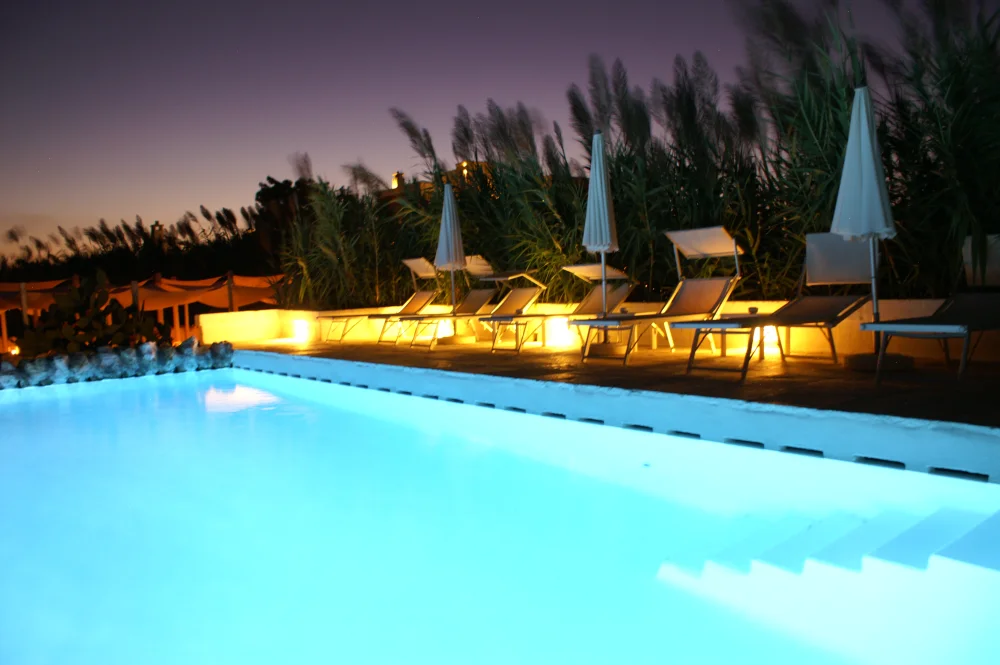
Masseria Cimino pool in the olive-growing plain, Puglia · © Walter Schärer / Wikimedia Commons — CC BY-SA 3.0
Where can you swim near Ostuni?
Ostuni is not a beach town where you can walk straight from the centre onto the sand. You need to travel to the coast. Allow around 15–20 minutes by car for the nearer stretches, plus parking and the final walk.
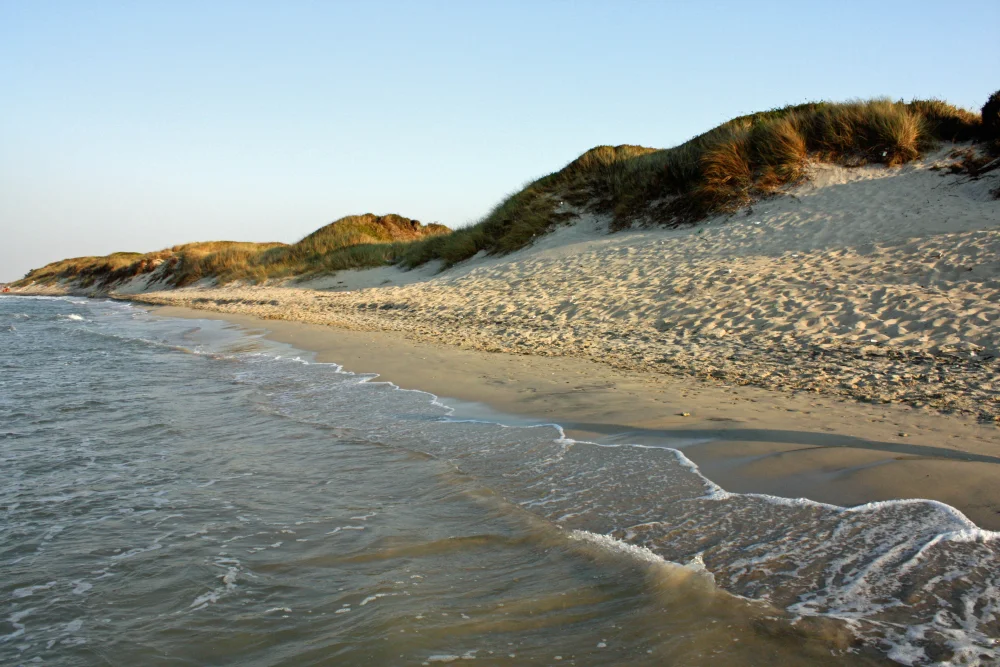
Public beach and dunes, Marina di Ostuni · © Carlo Pelagalli / Wikimedia Commons — CC BY-SA 3.0
Torre Pozzelle: small coves and Mediterranean scrub
Small coves alternate with rocks and Mediterranean scrub. Water shoes can make entering the sea easier, depending on the cove. Allow around €3–5 a day as a rough parking budget, then check the rate displayed for your season; this is not a guaranteed price for every car park.
Lido Morelli: choosing a sandy beach
With its dune-backed sandy beach, Morelli is the option I would consider for a family swim. Keep to the designated access paths and choose your beach to suit the day's wind. A lovely photo of calm water tells you little about the sea conditions on your day.
Torre Guaceto: respecting the protected zones
Further south, Torre Guaceto reserve combines coast, dunes and natural areas. Swimming is not allowed everywhere: it is prohibited in zone A and permitted in zones B and C from dawn to sunset. Check the reserve's rules and the signs on site.
Our guide to Puglia's beaches covers other stretches of the coast. If you have just one day in Ostuni, a beach trip is an alternative to the museum or a long afternoon break.
What to do around Ostuni in two days
After your day in Ostuni, choose a focus for the next. A masseria visit and a village, or two villages with lunch, already make a good programme. There is no need to fit olive oil, Alberobello, Cisternino, Locorotondo and a beach into the same day.
Cisternino and Locorotondo
Continue to Cisternino for its lanes and fornelli, butcher's shops that grill your chosen meat. Zio Pietro is an option for bombette. Then head to Locorotondo for a stroll between white houses and flower-filled balconies before returning at an easy pace.
Alberobello or an introduction to the olive groves
For the trulli, set aside a proper morning in Alberobello rather than squeezing it between two other excursions. Our guide to visiting Alberobello without the crowds helps you choose the quarters and time of day. An early start is helpful, but there is no need to arrive before 9am to enjoy the day.
A masseria offering an olive-grove visit and oil tasting is another way to explore the plain. Book with the farm: offering accommodation does not automatically mean it runs tours. To combine Ostuni with the rest of your trip, compare our towns to visit in Puglia too.
What to bring home from Ostuni
I would start with local olive oil, asking who produced it and where it comes from rather than choosing a pretty bottle alone. A tasting lets you compare flavours and take home an oil you will really want to use.
The pumo pugliese, a ceramic flower bud associated with prosperity and renewal, is a characteristic Puglian souvenir. For ceramics and leather sandals alike, ask where the item is made and which workshop produces it. That tells you more than assuming everything sold in an old-town lane is made locally.
When is the best time to visit Ostuni?
For walking, I would choose May, June, September or October. In July and August, use the hottest hours for a break rather than climbing every street in the centre. An early start is more comfortable, though evenings can remain very lively.
In late August, the feast of Sant'Oronzo and its Cavalcata provide another reason to visit. The celebrations traditionally run from 25 to 27 August; check the Ostuni council's annual programme for processions and traffic restrictions. For a trip combining the sea and sightseeing, our when to visit Puglia guide explains the differences between months.
Spend a few minutes on the ramparts as the light fades. The stone gently releases the day's warmth, olive groves darken and the streetlamps give the whitewash a honey-coloured glow. This is when I would leave the itinerary in my pocket.— Dolce Routes, Ostuni · Puglia
From white sand on the Ionian coast to rocky Adriatic coves, here are my tips for avoiding crowds and finding…
Read more →Puglia stretches for 400 kilometres. Here is how to choose the main sights, plan your journeys and avoid the tourist…
Read more →Frequently asked questions
How long do you need to visit Ostuni?
What should you see in Ostuni in one day?
Can you visit Ostuni without a car?
Where should you park to visit Ostuni?
Is Ostuni worth visiting in the evening?
Can you walk to the beach from the centre?
Masseria visit and olive-oil tasting in Ostuni