Skip to content
Dolce RoutesYour guide to Italy

Explore the guide

Home
My tripsRestore my saved trips
Across DolceRoutes

Find your
next guide.

Search the site’s city guides, itineraries and articles.

Explore DolceRoutes

Regions
Close this menu
My wishlist
Beaches

9 of the Best Beaches in Puglia

From white sand on the Ionian coast to rocky Adriatic coves, here are my tips for avoiding crowds and finding the clearest water in Italy's heel.

Puglia's two seas give its coastline two very different faces. On the Ionian side, sandy seabeds slope gently away from the shore. On the Adriatic, limestone cliffs shelter narrow coves. The real trick is choosing your coast to suit the wind.

Don't miss nearbyCastellana Caves: Tickets, Prices and Tour Routes📍 Castellana Grotte, province of Bari · ⏱ 50 or 100 minutes, depending on the route
Details & tickets →
Choosing your beach

The wind rule: choose your coast to suit the day

Puglia's two seas give its coastline two very different faces. On the Ionian side, sandy seabeds slope gently away from the shore. On the Adriatic, limestone cliffs shelter narrow coves. To make the most of swimming here, it helps to understand one simple rule.

When the tramontana, the northerly wind, blows, the Adriatic can become choppy and cloudy while the Ionian coast may be more sheltered. When the warm southerly scirocco dominates, the pattern can reverse: the Adriatic may be more sheltered and waves can build on the Ionian coast. The choice still depends on conditions at your chosen beach. My first move in the morning, even before coffee, is to check 3B Meteo or Windfinder before setting the satnav.

🧭 Plan your beach day around the wind
⬆️ Tramontana Ionian
⬇️ Scirocco Adriatic
🌊 No wind Both
⚠️ A car is essential

Public transport serves Puglia's isolated beaches poorly, so you need a hire car to explore this coastline. Compare prices on Rentalcars.com several months ahead: prices rise sharply in July and August.

At a glance

Puglia's 9 beaches compared

Beach Sea Beach surface August crowds Parking
Punta Prosciutto Ionian Fine white sand Very crowded €5–7
Punta della Suina Ionian Sand and rocks Moderate 6 €
Pescoluse Ionian Quartz sand Very crowded Free
Porto Selvaggio Ionian White pebbles Low Around €5
Lama Monachile Adriatic Rounded pebbles Very crowded Paid parking in town
Baia dei Turchi Adriatic Fine sand Moderate Around €5
Torre dell'Orso Adriatic Fine sand Moderate Free in the village
Cala dell'Acquaviva Adriatic Rock and concrete Low Roadside
Grotta della Poesia Adriatic Rock (sightseeing) Popular with visitors Included (€3)
✦
The Ionian coast

The Ionian coast: fine sand and clear, shallow water

The western side of the Salento peninsula has the broad sandy bays. Pale sand and the absence of posidonia, the seagrass that darkens the seabed, make for very clear water. The drawback is the sheer number of people packed onto the beaches in August.
1
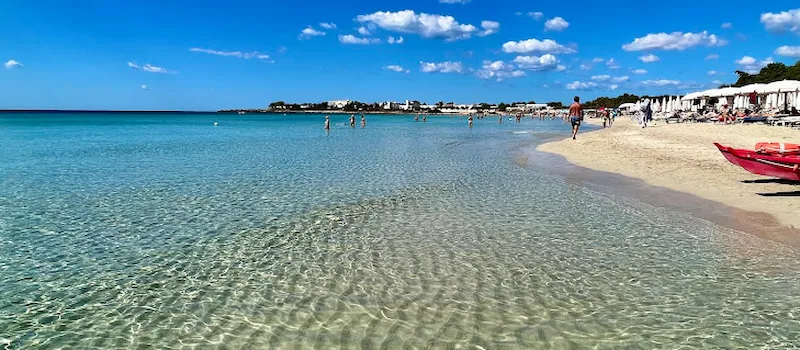
Punta Prosciutto beach, white sand and turquoise water, Porto Cesareo, Ionian Sea, Puglia

© Dolce Routes

Porto Cesareo · Ionian Sea · One of Puglia's finest beaches
Punta Prosciutto — turquoise water and pristine white sand

The water stays below knee height for the first fifty metres. The seabed is entirely pale sand, making the water particularly clear in calm weather when the tramontana blows. There is almost no natural shade, and the dunes covered in myrtle and rosemary are protected: laying a towel on them is prohibited.
In high season, make sure you arrive before 9 am. Stay a little inland to avoid coastal traffic jams. My choice in the area is still Masseria Tenuta Quintino, which needs booking well ahead: it gives access to Porto Cesareo's beaches without getting caught in the traffic.
📍 Porto Cesareo, Lecce 🅿️ €5–7 a day (Parcheggio Oasi) 💡 Best with the tramontana
2
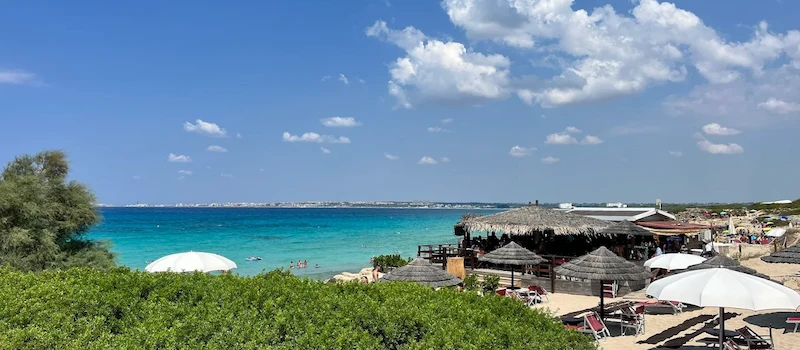
Coves and pine woodland at Punta della Suina, a natural beach near Gallipoli, Ionian Sea, Salento

© Dolce Routes

Gallipoli · Ionian Sea · Natural beach in the Salento
Punta della Suina — small coves among Gallipoli's pine woods

A long walk through the Aleppo pines of Pineta del Pizzo brings you to the water. Rather than one long sandy beach, there is a series of small sandy coves and flat rocks. The seabed is rocky in places, so bring water shoes to avoid slipping as you enter the sea. The large private lido is popular for sunset aperitivo.
Settle on the spiaggia libera, the public area on the left as you arrive, which is quieter in the morning. From 6 pm, find a spot on the west-facing rocks: watch Gallipoli's old town disappear into the setting sun with a Peroni from the beach bar.
📍 Gallipoli, Lecce 🅿️ €6 at the pine-wood entrance 👟 Water shoes recommended
3
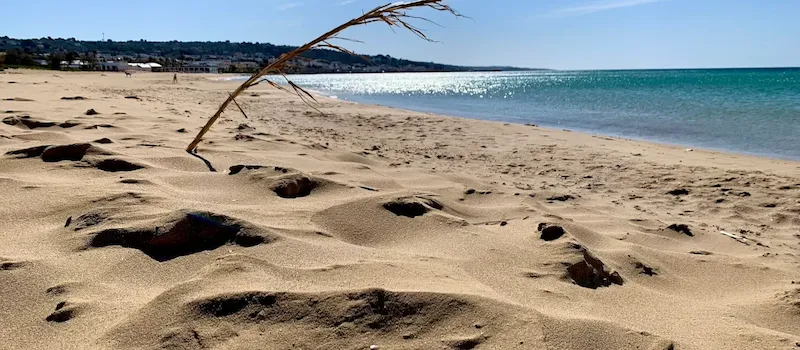
Clear waters at Pescoluse, nicknamed the Maldives of the Salento, Marina di Pescoluse, Puglia

© Dolce Routes

Marina di Pescoluse · Ionian Sea · Clear waters in Puglia
The "Maldive del Salento" — clear water and quartz sand

The clear water comes from tiny quartz fragments in the sand and shallow banks that keep cold currents out. It is a beautiful natural setting, although the nickname is pure local marketing. The area is heavily commercialised: rows of parasols stretch for kilometres, and two sunloungers can cost more than €50 a day in August.
My approach is to visit only between 7 and 9.30 am. First pick up a warm pasticciotto from Martinucci in Torre Vado, swim before the crowds arrive, then leave as the large car parks begin to fill.
📍 Marina di Pescoluse, Lecce 🅿️ Free roadside parking ⏰ Best only early in the morning
4
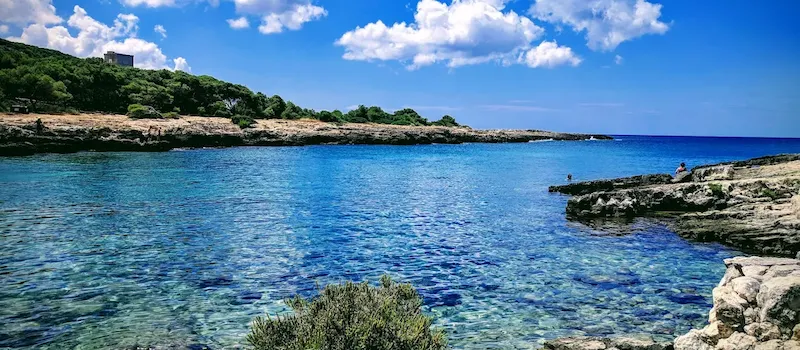
White-pebble bay at Porto Selvaggio, Nardò nature reserve, Ionian Sea, Puglia

© Dolce Routes

Nardò · Nature reserve · Unspoilt beach in Puglia
Porto Selvaggio — nature reserve, white pebbles and cold springs

A nature reserve without a grain of sand. A 20–30-minute walk downhill through the pines leads to this white-pebble bay. Underground freshwater springs flow straight into it: you can be swimming in a sea at 26°C and suddenly cross a current at 16°C, a bracing change after lunch.

There are no facilities here: no toilets, parasol hire or bins. Buy puccie, round filled bread rolls, and chilled water from a shop in Nardò before walking down, and take every bit of rubbish back with you.
📍 Nardò, Lecce 🅿️ Villa Tafuri or Torre dell'Alto, around €5 🥾 20–30-minute walk downhill
Rentalcars
Car hire in Puglia
★★★★★
From €28
/ day
Compare deals →
✦
The Adriatic coast

The Adriatic coast: natural coves and deep water near Polignano a Mare

The eastern coast, facing Albania and Greece, is more rugged. Water becomes deep very quickly, just a few metres from shore. Currents are stronger, and cliffs fall steeply to the sea.
5
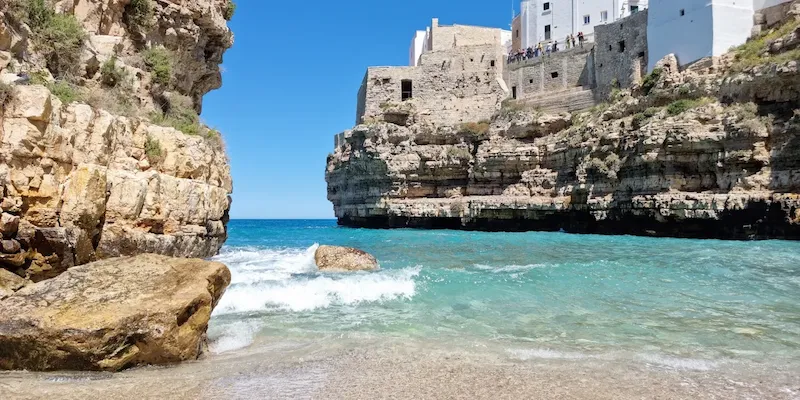
Lama Monachile cove between white cliffs, Polignano a Mare, Adriatic Sea, Puglia

© Dolce Routes

Polignano a Mare · Adriatic Sea · One of Puglia's finest coves
Lama Monachile — Polignano a Mare's famous cove

A rounded-pebble cove wedged between two 20-metre cliffs topped by the old town's white houses. The water gets deep quickly. Pebbles rolling in the backwash make a loud echo against the rock walls. Space is limited, and heat builds up easily because the cliffs block the breeze.
I would not plan an entire afternoon here. Go for a 30-minute swim around 8.30 am. To explore the sea caves, booking a GetYourGuide boat trip from San Vito harbour or Cala Paura is much more practical. From the boat, you can appreciate the shape of the cliffs without the beach crowds.
📍 Polignano a Mare, Bari 🅿️ Paid car parks in town ⏰ Best only before 9 am
6
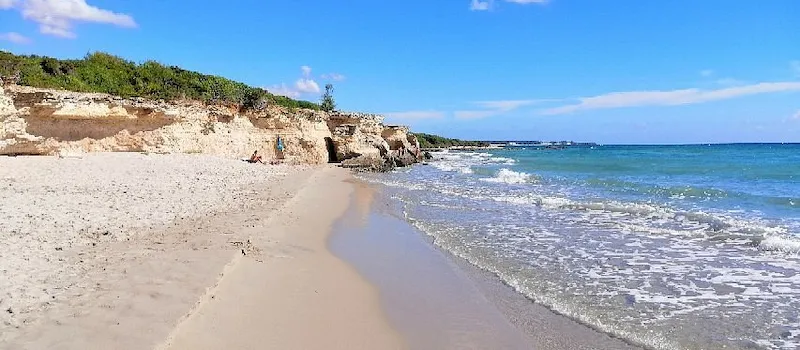
Baia dei Turchi, a fine-sand beach below the pines, Otranto, Adriatic Sea, Salento

© Dolce Routes

Otranto · Adriatic Sea · A tucked-away Salento beach
Baia dei Turchi — near Otranto, a 20-minute walk through the pines

A strip of fine sand tucked against an ochre rock wall, reached only after a 15–20-minute walk through dense pine woods. The beach is very narrow. When an easterly wind blows, waves considerably reduce the sandy space and can bring seaweed ashore.
The public area shrinks year by year as private concessions expand. To find a free spot, walk to the far northern end of the bay along the cliff. The change from shaded pine woods to heat reflected off the rock is marked, so bring a parasol.
📍 Otranto, Lecce 🅿️ Parcheggio Santo Stefano, around €5 🥾 15–20-minute walk from the car park
7
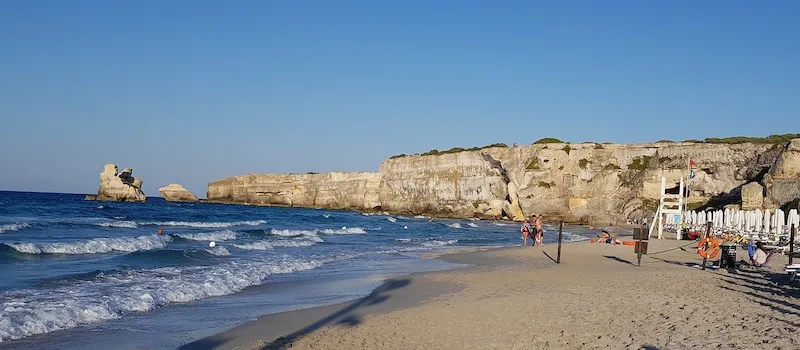
Torre dell'Orso bay with the Two Sisters rock stacks, Melendugno, Adriatic Sea, Lecce

© Dolce Routes

Melendugno · Adriatic Sea · A family beach with clear water
Torre dell'Orso — shallow water and the Two Sisters rock stacks

A curved bay of fine sand framed by two huge rock formations known locally as the Two Sisters. It is one of the few Adriatic spots where the water stays shallow far from shore, ideal when the sea is calm. Direct access from the village makes it very popular, with plenty of bars overlooking the beach.
Before or after a swim, stop at Dentoni for an iced caffè leccese on the terrace. The high cliff and pine woods put the beach in shade by mid-afternoon, so come between 8 am and 1 pm for sunshine and the water's best colours.
📍 Torre dell'Orso, Lecce 🅿️ Free in the village ☀️ Shade after 2 pm (cliff and pines)
8
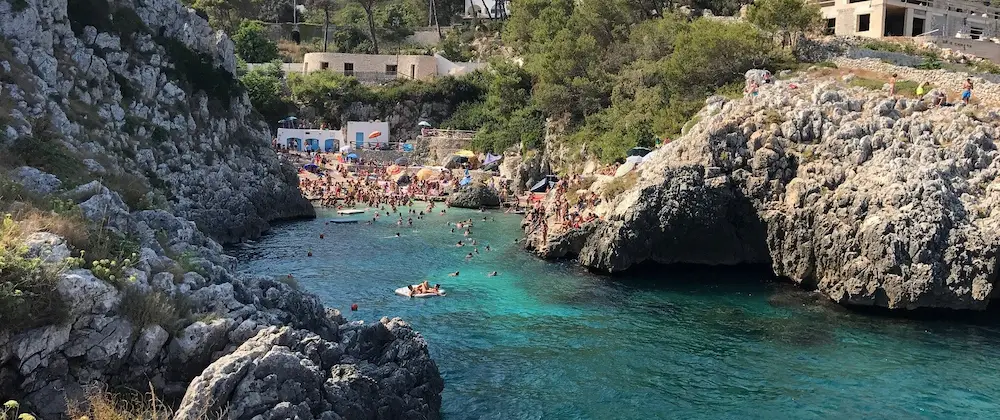
Cala dell'Acquaviva, a rocky inlet with cold springs, Marittima, Castro, Adriatic Sea, Puglia

© Dolce Routes

Marittima · Castro · A natural cove with cold water
Cala dell'Acquaviva — Castro's rocky inlet and cold springs

A tiny, deeply enclosed inlet south of Castro. There is no beach as such: you lay your towel on concrete terraces or directly on the rock. A steep staircase leads down from the SP358 coastal road. As at Porto Selvaggio, many cold springs flow into the inlet, making the water bracing, often around 18°C even in August.
Park carefully along the SP358, paying attention to solid lines: municipal police issue fines quickly in summer. This is an ideal stop for a quick 45-minute swim on a drive along the coastal road between Otranto and Leuca.
📍 Marittima, Lecce 🅿️ SP358 roadside (check road markings) 🌡️ Cold water year-round (underground springs)
9
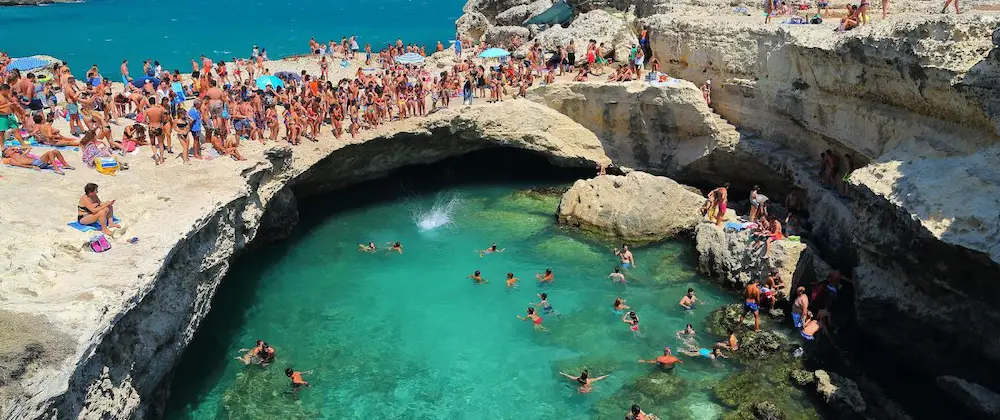
Grotta della Poesia natural pool, Roca Vecchia archaeological site, Adriatic Sea, Lecce

© Dolce Routes

Roca Vecchia · Archaeological and geological site in Puglia
Grotta della Poesia — natural pool and prehistoric Roca Vecchia

An enormous natural pool hollowed out of limestone, now part of the Roca Vecchia archaeological area. Swimming has been strictly prohibited by a municipal order since 2019, with fines of up to €400. Foot traffic was dangerously eroding the rock.

It is worth stopping for photographs. Pay the entry fee, around €3, walk around the pool to see its deep water, then drive on to Torre dell'Orso, just five minutes to the south.
📍 Roca Vecchia, Lecce 💶 Entry around €3 🚫 No swimming (fines up to €400)
GetYourGuide
Boat trip from Polignano a Mare
Sea caves · Local guide · Departures from San Vito harbour
34 €
/ person
Check availability →
✦
The local routine

The local routine: leave the beach at 1 pm, return at 5 pm

Staying on a Salento beach between 1 and 4 pm in August is hard going: the sun is fierce, the sand burns and crowds are at their peak.

Follow the local routine and fold up your parasol around 1 pm. Find a trattoria or masseria inland, order friselle topped with tomatoes and olive oil, eat in the shade of an olive tree or pergola, then rest somewhere cool. The sea will still be there around 5 pm, when the light softens and most visitors head back to shower their children. This is when the coast offers its best swims.

“Leave when everyone else arrives. Come back when they leave.”
The Salento's unwritten rule
💡 A practical tip

Avoid the beaches between 1 and 4 pm. Find an inland farmhouse restaurant ahead of time, with a pergola and a short menu. After a quiet two-hour siesta, return to the sea around 5 pm for much better conditions: golden light, a third of the crowd and water that is still warm.

Puglia's best beaches: frequently asked questions

Which are the best sandy beaches in Puglia?

For broad stretches of fine sand, focus on the Ionian west coast. Punta Prosciutto and the Maldives of the Salento at Pescoluse are known for pale sand and clear water over a light sandy seabed. On the Adriatic, Baia dei Turchi and Torre dell'Orso also have beautiful sandy beaches.

Ionian or Adriatic: which coast should you choose in Puglia?

It depends on how you feel about waves and the seabed. The Ionian suits children and non-swimmers, with shallow water, sandy bottoms and clear sea for several dozen metres from shore. The Adriatic coast is more rugged, with natural coves, limestone cliffs rising 20 metres above the sea, particularly around Polignano a Mare, and water that deepens very quickly.

Should you choose a free public beach or a private lido?

Public beaches are free, but in July and August you need to arrive before 9 am to find room for a parasol. Lidos provide showers, changing cabins, food and guaranteed sunloungers, but cost considerably more: expect an average of €30–50 a day for two people. A good balance is to alternate free natural coves in the morning with a lido on days when you want full comfort without carrying equipment. To choose a month with fewer crowds and less heat, see when to visit Puglia.

Where can you find the calmest beaches in Puglia?

It depends on the day's wind and local sea conditions. With a northerly tramontana, the Ionian coast around Gallipoli, Porto Cesareo or Pescoluse may be more sheltered. With a southerly or easterly scirocco, the Adriatic around Otranto or Torre dell'Orso may offer more shelter. Download 3B Meteo and check the wind direction over breakfast each morning, then check beach notices and lifeguards' advice before swimming.

Are there many jellyfish in Puglia, and how can you avoid them?

Jellyfish numbers vary from year to year and with the currents. Jellyfish can be carried towards or away from a beach by wind and currents, but an offshore wind does not guarantee calm water or an absence of jellyfish. Check the local sea forecast, beach notices and lifeguards' advice before swimming.
Related guides