Visiting Herculaneum: The Roman Town Where Wood Survived
Pompeii shows a Roman city's scale; Herculaneum reveals its intimate details, with surviving storeys and original carbonised beams.
Walking through Herculaneum gives you a sense of the scale of first-century homes, with their upper floors, balconies and timber. Its compact streets take two or three hours to explore. The eruption preserved extraordinary details through carbonisation and burial.
Why wood survived at Herculaneum
In AD 79, Vesuvius abruptly ended life on its slopes. Nearby Herculaneum was struck by pyroclastic surges: waves of gas, ash and volcanic debris above 400°C.
According to the archaeological park, these flows travelled at over 80 km/h, reaching the town before eruption deposits gradually buried its buildings.
That sequence explains the preservation: heat carbonised organic material, then rapid burial protected it from ordinary decay.
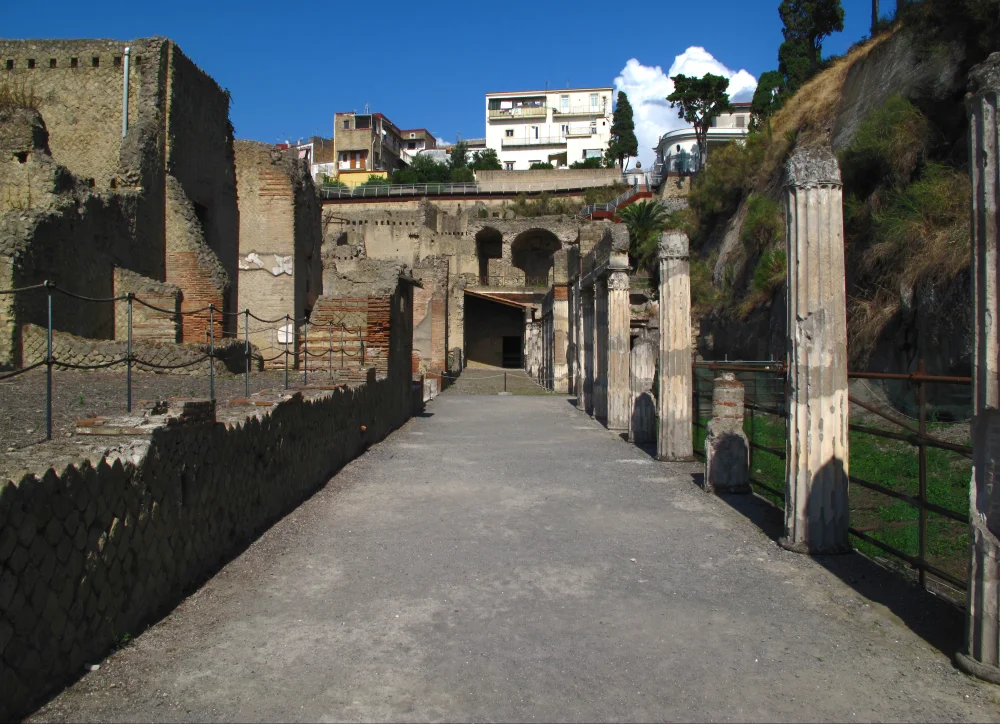
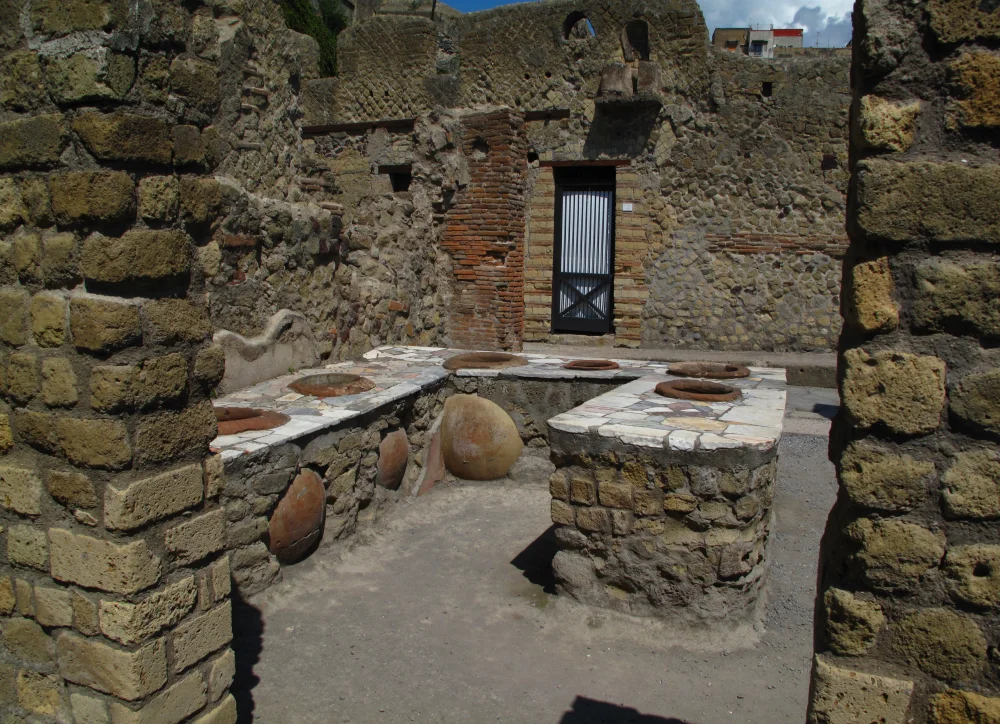
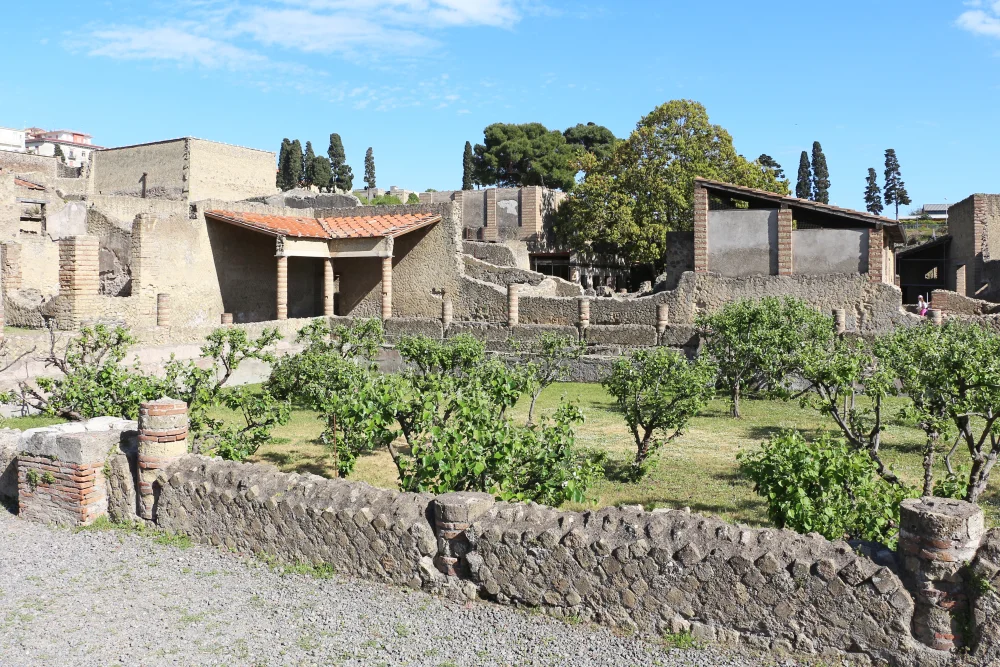
© Bernard Gagnon / Wikimedia Commons — CC BY 4.0
The heat killed residents who remained. It carbonised organic material, changing its substance without always destroying its shape.
Flows and deposits then buried the town beneath up to around twenty metres of volcanic material, sealing streets and houses for centuries.
Beams, doors, stairs, partitions, furniture, food, ropes and wax tablets were preserved in exceptional conditions. Along with the frescoes and mosaics, these everyday objects help us understand how people actually lived in the town.
The volcanic wall and modern town
The park lies in town, rather than open countryside. Its Corso Resina ticket office is in central Ercolano.
Lean over the ticket office's metal railing and the difference in level is immediately striking. Twenty metres below, Roman roofs lie at the bottom of a steep-sided excavation cut vertically through the deposits.
Above, modern Ercolano's 1960s buildings cling to the excavation edge, with washing on balconies and scooters in the streets.
This cross-section explains why most of Herculaneum remains buried. Just over four of its estimated twenty hectares are visible; further excavation would reach beneath whole modern neighbourhoods.
Shafts and tunnels dug for Charles of Bourbon in the 18th century still cross the ground below, reaching the theatre and buildings trapped beneath modern streets.
A route through the Roman streets
Your descent into Herculaneum begins with the long access ramp leading to the ancient waterfront. At the bottom, a row of dark brick vaults faces the old stretch of sandy beach. These are the Fornici.
In AD 79, the sea reached this line. From 1980, archaeologists found around 300 skeletons in nine of the twelve vaults, where residents had gathered hoping to escape or be rescued by sea.
Jewellery, coins, keys, amulets and tools show what people considered essential to take when leaving, perhaps expecting to return.
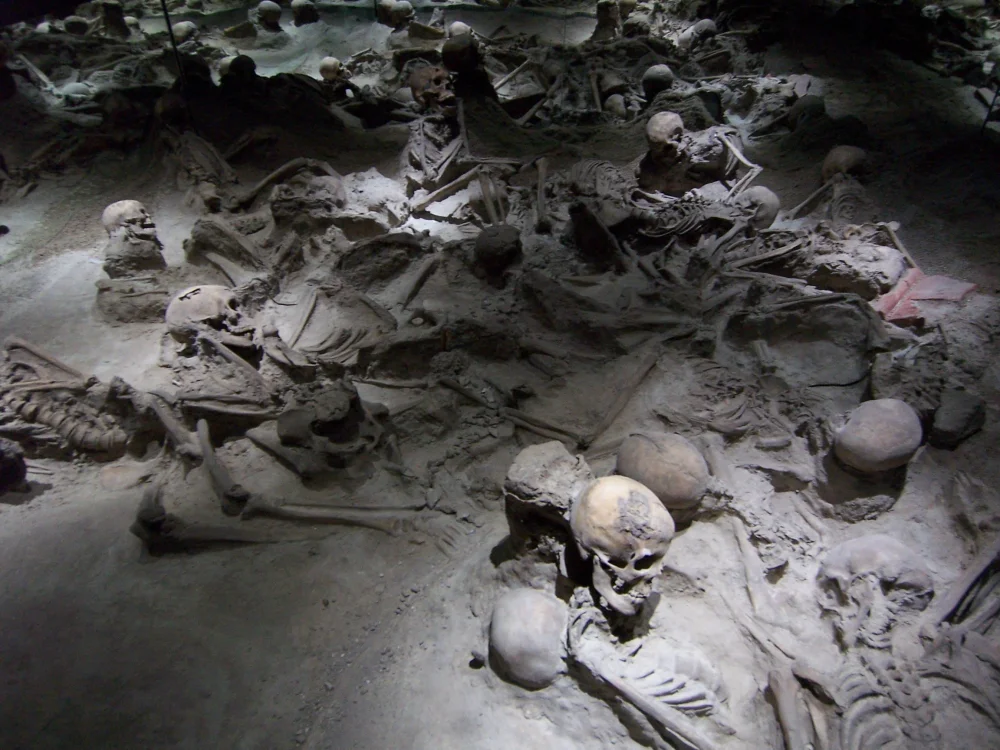
© Johnnyrotten, Italian Wikipedia / Wikimedia Commons — Public domain
Head uphill into the compact excavated grid, with three broad streets paved in grey basalt. Gradients are relatively modest once you reach ancient street level.
The House of the Wooden Partition is an early highlight. Its street façade retains an upper floor and balconies.
Inside, a carbonised wooden screen separates the atrium from the tablinum reception room. Grooved sliding panels and substantial bronze hinges remain in their original frame.
Further along, the shop beside the House of Neptune and Amphitrite retains blackened wooden shelves and wine amphorae, as though the shopkeeper has just stepped away.
In the adjoining courtyard, a blue and green glass mosaic depicts Neptune and Amphitrite in vivid colour.
On the same pavement, you pass the town's thermopolium. This is more than a bare ruin: the substantial counters are faced with fragments of reused coloured marble, with large terracotta jars set into them.
These deep vessels, called dolia, were set into the masonry to store and dispense food or drink. Above all, the counter brings a familiar scene back into focus: a shop opening directly onto the street.
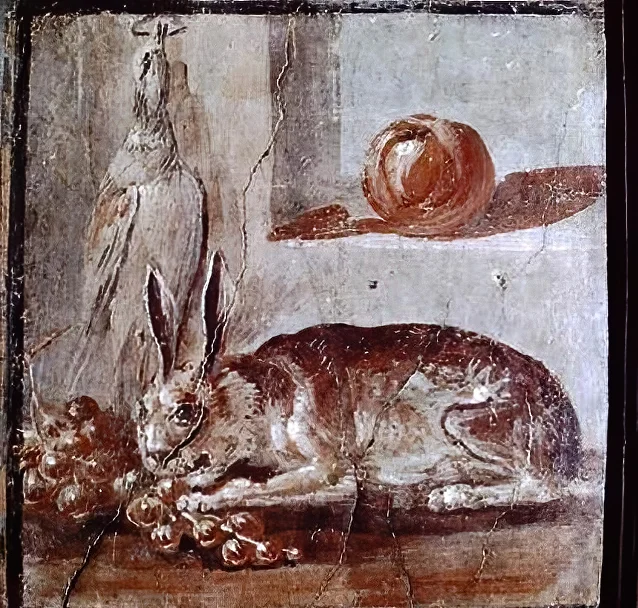
© Stanley Jashemski / Wikimedia Commons — Public domain
Further south, the House of the Deer reveals the wealth of the Roman elite: a large home designed around sea views.
Its floors use marble from across the Mediterranean. Refined paintings on black backgrounds decorate the summer dining room, once facing gardens and sea.
Return towards the Central Baths, where marble changing-room benches remain clearly visible.
Look up in the hot room: parallel grooves in the vaulting are generally interpreted as channels directing condensation towards the sides.
Finish at the square Sacellum of the Augustales, dedicated to the imperial cult. Red and deep-blue frescoes depict Hercules entering Olympus.
Hours, booking and summer heat
- On-site admission: around €16; online advance-sale fees add a few euros
- Reduced admission: €2 for eligible EU citizens aged 18–25
- Free admission for under-18s
- 16 March–14 October: 8.30 am–7.30 pm, last entry 6 pm
- 15 October–15 March: closes 5 pm, ticket office closes 3.30 pm
These hours and prices were checked against the park's official website in July 2026. Two seasonal schedules apply, with shorter winter hours; usual annual closures are 1 January and 25 December.
Heat is summer's main challenge. Basalt streets and volcanic walls store warmth, with limited shade or resting places. Bring plenty of water, come early and wear closed shoes; the park urges extra care during heatwaves.
High-season queues can build by mid-morning on Corso Resina's narrow pavement. Booking ahead secures your entry and lets you show a QR code at the entrance. Compare options in our Herculaneum ticket guide.
The park occasionally runs evening and special openings. Dates, hours, accessible areas and prices change annually: check the official calendar before planning an evening visit.
Reaching the ruins from Naples or Sorrento
From Naples or Sorrento, the train is usually the simplest option. If Naples is your base, our Naples guide helps you plan the rest of your stay around this day trip. Traffic around Vesuvius can be heavy, although the park is also accessible by car via the A3, taking the Ercolano Scavi exit. Private car parks and a municipal car park are available nearby.
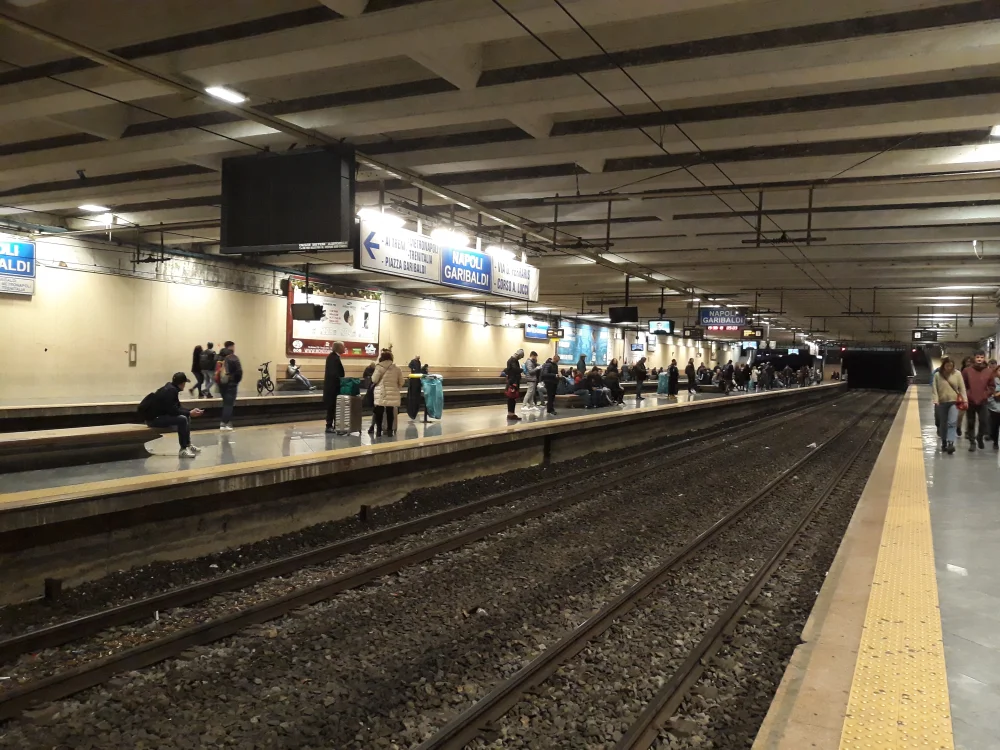
© Simon Burchell / Wikimedia Commons — CC BY-SA 4.0
From Napoli Garibaldi at Naples Central station, or from the Sorrento peninsula, take the local Circumvesuviana railway and get off at Ercolano Scavi station.
From Garibaldi, the journey is usually around twenty minutes. On this busy local railway, keep an eye on your belongings and check the day's timetable. The more visitor-oriented Campania Express also serves Ercolano Scavi seasonally.
From the station, walk straight down Via IV Novembre. The park gives an approximate six-minute walk to the entrance.
The entrance is ahead, just across the Corso Resina junction.
Combining Herculaneum and Vesuvius
A morning at Herculaneum and afternoon at Vesuvius' crater fit well into a Campania itinerary. Vesuvio Express has an office outside Ercolano Scavi station.
Packages usually combine return shuttle travel and crater entry. Check the exact slot, price and seasonal availability before combining both visits.
If travelling independently, book Gran Cono admission before leaving: there is no normal ticket office at the trail entrance. Download the ticket and QR code, as mobile reception can be patchy uphill.
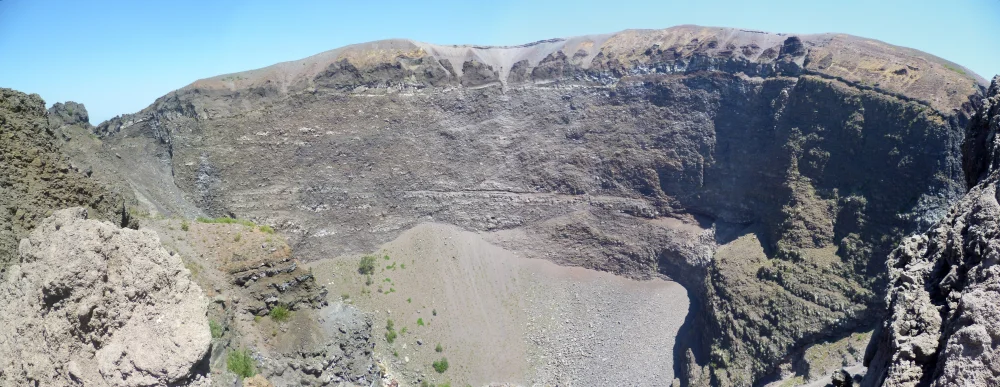
© Kim Traynor / Wikimedia Commons — CC BY-SA 3.0
From the drop-off, a steep walk of roughly a kilometre over red lapilli brings you to the rim. Fumaroles rise from the inner walls, sometimes with a sulphurous smell.
Wear closed trainers: fine volcanic dust and gravel quickly get into sandals.
Where to eat in modern Ercolano
The route from station to ruins has plenty of multilingual tourist menus. For a quick lunch at local prices, try shops used by residents.
Along the slope towards the site, traditional grocers and delis make generous panini to order behind their chilled counters. Choose a round roll with machine-sliced local porchetta, fresh provola and a generous spoonful of friarielli, the region's broccoli rabe cooked in olive oil. The roll goes into the sandwich press: the cheese melts, while the bitter greens balance the rich meat. It costs around €6 and comes wrapped in brown paper to take away.
About 300 metres left of the ticket office at Corso Resina 261, this bottle-lined wine bar focuses on Campanian grapes: Fiano di Avellino, Greco di Tufo and Aglianico. Expect regional charcuterie or seafood pasta, around €25–30 per person for a full sit-down meal.
Staying in Ercolano: hotels and B&Bs near the ruins
Staying in Ercolano lets you avoid the bustle of Naples' historic centre while keeping a convenient position on the railway. Naples is to the north; Pompeii and Sorrento are accessible to the south. To compare ways of organising your stay, take a look at our 3-day Naples itinerary too.
Use Booking to compare accommodation near the ruins, station and Miglio d'Oro. Seasonal prices vary: compare the total with a Naples stay.
Look for B&Bs or apartments uphill along the Miglio d'Oro, the ‘Golden Mile’, near 18th-century Vesuvian villas such as Villa Campolieto. The wider roads can make manoeuvring a hire car easier.
Drivers should still confirm private parking: overnight street parking is not straightforward everywhere.
Why Herculaneum deserves its own visit
Herculaneum preserves unusually fragile things: upper floors, doors, partitions, furniture and everyday objects rarely seen so clearly at ancient sites.
The excavated area is compact. Two or three hours lets you explore streets, principal houses and the old waterfront without an endurance test.
Do not look only at the floors and frescoes. Herculaneum's distinctive character is above eye level too: carbonised beams, balconies and surviving spaces reveal the original height of Roman homes.
This compact scale makes the town especially easy to read. You can quickly see how houses, shops, baths and places of worship fitted into the same urban grid.
At Herculaneum, look up. It is one of the rare surviving Roman urban sites where carbonised wooden elements let you make out upper floors, ceilings and the openings of houses. Start by heading down to the boat shelters and the ancient beach, then gradually work your way back up through the streets and homes.
From the chaos of Naples' historic centre to Ravello's overhanging terraces: five full days following regional railway lines and the…
Read more →A three-hour route through Pompeii, from the Forum to the amphitheatre, with advice on named tickets, arrival windows and getting…
Read more →