San Gregorio Armeno, Naples: Nativity Scenes, Prices & Visiting Tips
A lane under 200 metres long where terracotta shepherds, angels and Maradonas are made year-round. Find out when to come, how to explore and what to buy for your budget.
Between Via dei Tribunali and Spaccanapoli, Via San Gregorio Armeno revolves around the Neapolitan nativity scene from 1 January to 31 December. Here is how to get there, when to visit depending on what you want to see, and how to distinguish workshop figures from mass-produced pieces.
In Naples, Christmas never quite ends. In a historic-centre lane between two of the ancient Greek city's main streets, generations of craft families have shaped terracotta shepherds, bakers, Magi and angels. Neapolitans call it the street of the shepherds, 'o vico d''e pasture. On maps, it is Via San Gregorio Armeno.
Visitors often pass through in ten minutes, carried by the crowd without really looking. In doing so, they miss an important tradition: the Neapolitan nativity scene places the Nativity in a bustling village of traders, taverns and musicians.
Here is how to get there, when to visit for the experience you want, what the workshops sell and how much a figurine costs. The religious complex that gave the street its name also deserves a visit.
Via San Gregorio Armeno: an ancient Greek lane turned nativity street
Via San Gregorio Armeno is less than 200 metres long. It descends from Piazza San Gaetano on Via dei Tribunali to Via San Biagio dei Librai, the stretch of Spaccanapoli running towards Via Duomo. It is one of the small perpendicular streets linking ancient Neapolis' main axes. Piazza San Gaetano itself occupies the former agora.
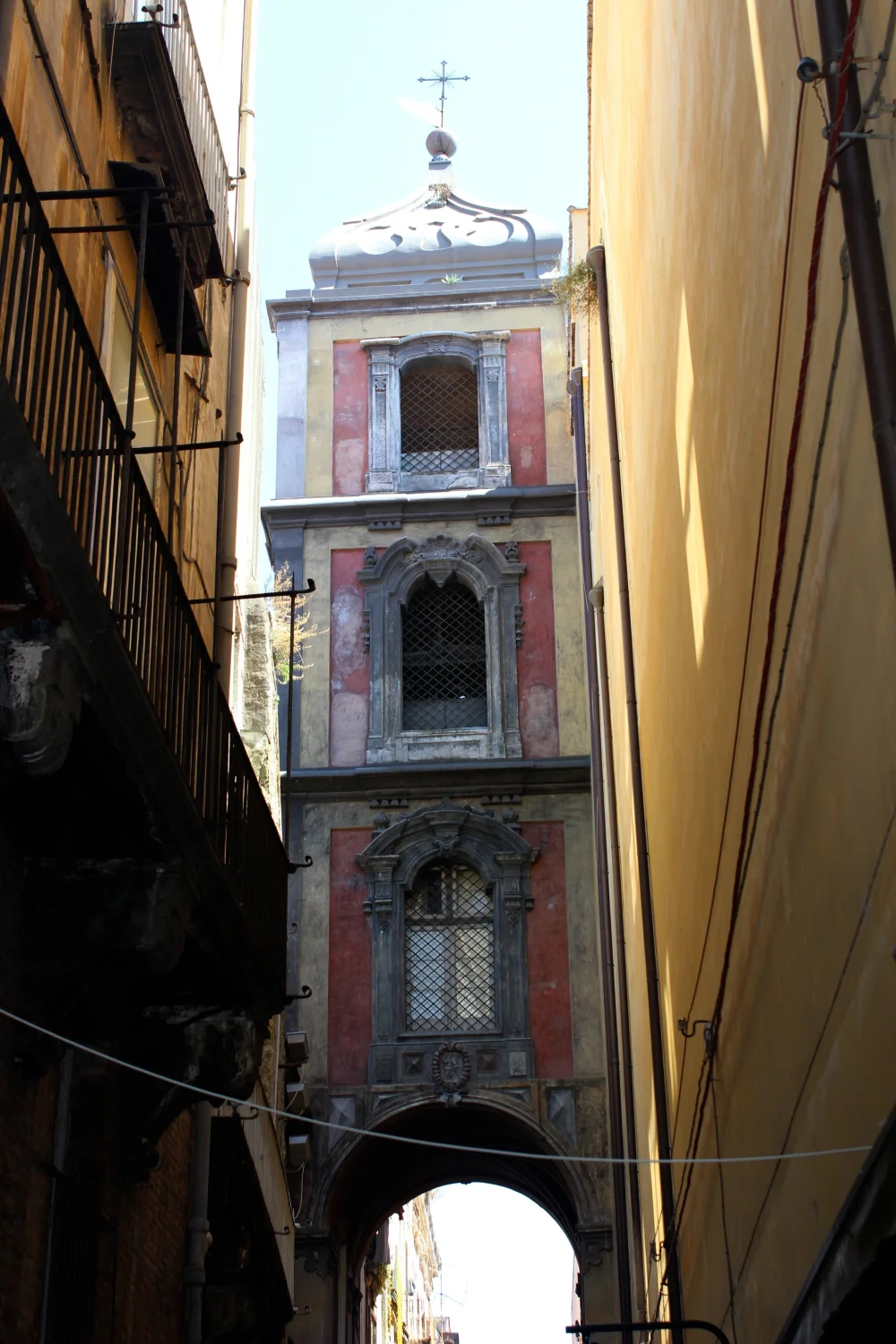
© Miguel Hermoso Cuesta / Wikimedia Commons — CC BY-SA 4.0
Tradition traces the craft far back. A temple to Ceres is said to have stood here in antiquity, with residents offering small terracotta figurines made in nearby workshops. Whether or not the story persuades you, terracotta still sustains the street.
Today, shops line both sides, stalls spill onto the paving and the church bell tower spans the street overhead like a bridge, linking the former monastery's two parts.
The passage is narrow. Two people pass comfortably on a spring morning; in December, progress is shoulder to shoulder.
Getting to San Gregorio Armeno by metro and on foot
Explore the street on foot; walking is also the most sensible way to get there, as a car is no help in the historic centre's maze of lanes.
The simplest option is metro line 1. From Duomo station, walk up Via Duomo to Via San Biagio dei Librai or Via dei Tribunali, then head west: nativity street appears on your left or right after a few minutes. The walk takes under ten minutes.
From Dante station, allow around ten minutes: pass through Port'Alba, cross Piazza Bellini and follow Via dei Tribunali to Piazza San Gaetano.
I recommend entering at the top from Piazza San Gaetano and walking down to Spaccanapoli. You encounter the bell tower on arrival and emerge onto a lively street for continuing your walk. December crowd controls may mean you have to walk the other way, as explained below.
The street itself is free: a public road you can cross at any time, day or night. Shops set their own hours, varying by workshop and season. The religious complex has shorter hours, and the cloister charges admission. Confusing these three things often causes disappointment: at 3pm the street and workshops may be open, but the church has long closed.
When to visit San Gregorio Armeno: Christmas atmosphere or quiet
There is no single best time for San Gregorio Armeno. It depends on what you want to experience.
December for the atmosphere
From late November to Epiphany, the street becomes a celebration. Workshops display their full stock, stalls reach towards balconies, new caricatures appear and Neapolitans come to add to their own nativity scenes. Crowds peak from the Immaculate Conception holiday around 8 December through Christmas. It is wonderful, and slow-moving.
In 2025, the city imposed a pedestrian one-way system on the busiest days: weekends in late November and December, plus the 8 December holiday period, from 9am to 8pm, and on 23 December until 2pm.
Direction varied by date, sometimes from Piazza San Gaetano towards Spaccanapoli, sometimes the reverse. Similar measures have returned at Christmas for several years. On a December weekend, follow entrance signs and expect to exit at the opposite end.
For the festive atmosphere without spending an hour getting through, I would come early on a weekday morning. Decorations are up, but there is still room to stop at a window.
October and November for unhurried shopping
This is when I would come to buy something. Workshops are ready for Christmas, shelves are full and there is room to compare, hold a figurine and speak to the person who painted it.
The rest of the year for watching craftspeople work
In spring and summer, especially weekday mornings, the street returns to a neighbourhood rhythm. Some shops slow down, but several workshops stay open year-round, giving you a better chance of seeing a head modelled or face painted behind the window.
One last point about crowds: in a lane this tight, pickpockets know where to stand. Keep your bag closed and in front of you, and your phone in a front pocket.
San Gregorio Armeno church and cloister: hours and admission
Among the shops, a grey façade and large carved wooden doorway are easily missed. This is San Gregorio Armeno church, founded by nuns arriving from Constantinople with relics of St Gregory the Illuminator, Armenia's evangeliser. Neapolitans also call it Santa Patrizia, after the saint buried here and venerated alongside San Gennaro.
Look up inside: Flemish painter Teodoro d'Errico's coffered ceiling is covered with gilding and paintings, while Luca Giordano frescoes decorate the dome. Church entry is free, but opening is limited: generally 9am–noon on weekdays and until 1pm at weekends. Come in the morning if you want to visit.
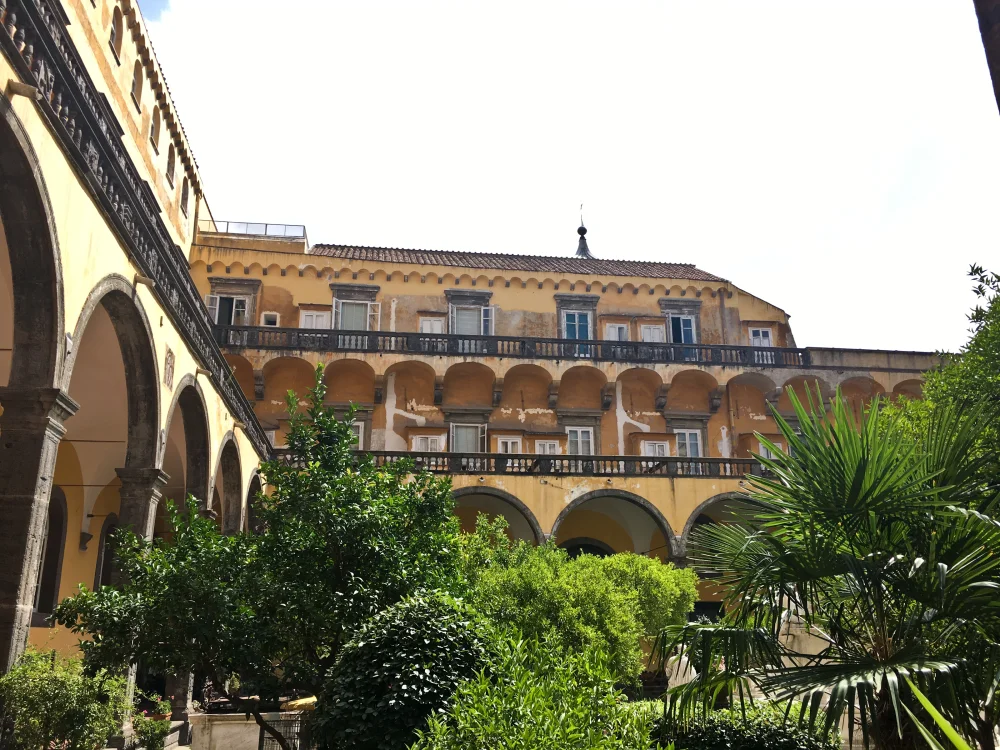
Ruthven / Wikimedia Commons — CC0
The cloister is the real surprise. A separate entrance from the street takes you straight from the noisy stalls into a citrus garden surrounded by arcades. At its centre, a baroque marble fountain is framed by statues of Christ and the Samaritan woman, carved by Matteo Bottiglieri in the 18th century. Nuns still run the convent, whose former cells overlook the garden.
Cloister hours differ from church hours; morning offers the best chance of finding both open. Allow up to €7 for admission. Some visitors find that high for a short stop; if you enjoy peaceful spaces within the city, I think it worthwhile, especially in December.
| Venue | Getting there | Opening hours |
|---|---|---|
| The street | Free public street | Accessible at any time, day or night |
| Shops | Free | Individual hours, varying by workshop and season |
| The church | Free entry | Generally weekdays 9am–noon, weekends until 1pm |
| The cloister | Paid admission: allow up to €7 | Separate hours from the church; morning gives the best chance of both being open |
What Neapolitan nativity workshops sell
A Neapolitan nativity scene includes much more than the Holy Family, ox and donkey. A whole village surrounds the Nativity grotto, and that village fills the shops.
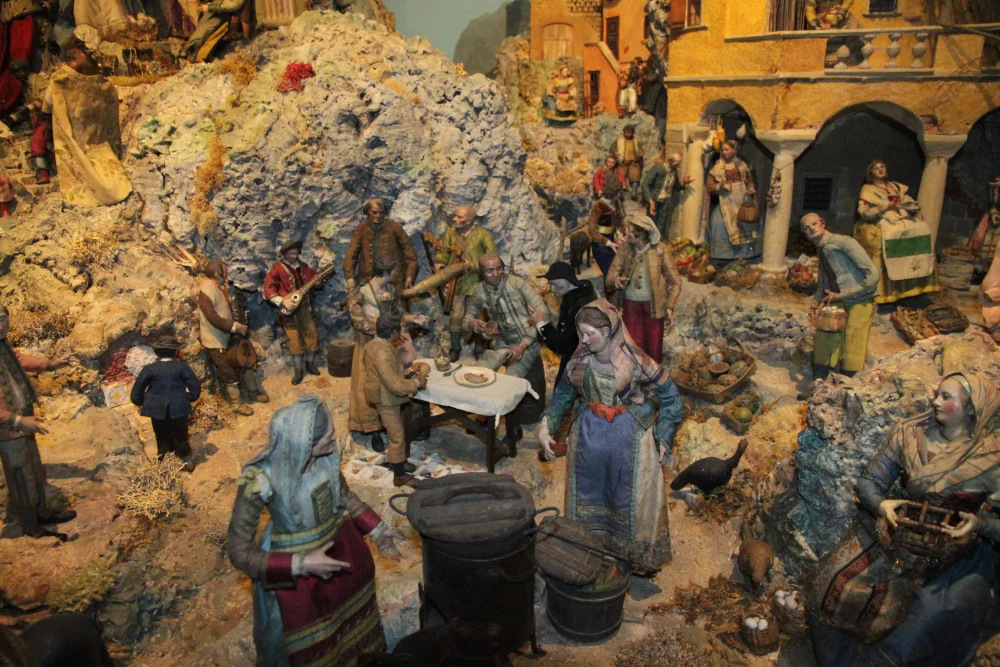
© Matutinho / Wikimedia Commons — CC BY-SA 4.0
First come the pastori, the characters: shepherds, of course, but also the baker with his bread, fishmonger, wine seller, innkeeper, musicians, sleeping young shepherd Benino and Magi in 18th-century court dress. Each is sold separately in several sizes, letting you build a scene gradually, year after year, as many Neapolitan families do.
Then come cork grottoes, multi-storey houses, wells, ovens with electric fires, flowing fountains, tiny baskets of terracotta vegetables, fish, miniature hams and cheeses. Accessories are inexpensive and often make a lovely gift on their own.
Finally, figurines make passers-by smile: footballers, singers, politicians, popes and faces from the year's news. Maradona has been everywhere for years. The idea is older: Neapolitan nativity scenes have always mixed contemporary figures with the Nativity. Today's celebrity caricatures developed particularly from the 1990s, and workshops follow the news closely.
You will also see plenty of Pulcinella figures and cornicelli, the little good-luck horns. For other city souvenirs, see my ideas for what to bring home from Naples.
Distinguishing workshop figurines from mass-produced pieces
Not every shop offers the same thing. Some display pieces made a few metres away; others unpack mass-produced resin or plaster figures. That is not inherently wrong, but know what you are paying for.
The finest pieces follow 18th-century techniques. The head is modelled in terracotta and hand-painted; hands and feet are terracotta or carved wood. A tow-stuffed body on a wire frame allows different poses, and it is dressed in real fabric. The most detailed figures have glass eyes.
For a first impression, I look at three things.
-
Faces first: two handmade shepherd figures of the same model have slightly different expressions; a mass-produced figurine looks identical to the others on the shelf.
-
Then hands and clothing: stitched fabric and individually modelled fingers look different from a costume moulded as one piece.
-
Finally, the shop itself: a workbench and drying heads at the back show that work really takes place here.
This does not establish the origin of every shelf item. Before buying an expensive piece, ask who made it and what was modelled, painted or dressed on site.
A few families built the street's reputation. The Ferrigno family workshop, whose tradition dates to 1836, is among the oldest and best known, recognised for expressive faces. Large pieces from these workshops often have to be ordered, so expect a wait.
Terracotta figurines are fragile. I would keep one in hand luggage, cushioned securely in clothing.
How much do San Gregorio Armeno figurines cost?
Prices vary by workshop, size, finish and season. These amounts draw on 2026 prices at selected street workshops, including their online shops: use them as rough budget guidance, not a fixed price list.
Small mass-produced resin or simple terracotta figures cost a few euros, often under €15. Workshop caricatures of footballers or singers run around €25–30, more for a detailed piece.
A craftsperson's small 7–10 cm figure costs around €10–30, depending on whether it is simply painted or dressed in fabric. At 12 cm, a dressed figure starts around €30 and rises with finer work.
Large 18th-century-style characters, 20–35 cm tall, dressed in fabric and sometimes with glass eyes, start around €120–150 and reach several hundred euros. Complete nativity scenes from major workshops cost thousands.
To begin a scene, a small undecorated terracotta Nativity with 8 cm figures costs around €60 from a craftsperson. A lit 30 cm stable costs around €30. Add shepherds and traders one at a time, as Neapolitans do.
| Piece | Approximate 2026 budget, not fixed prices |
|---|---|
| Small mass-produced figure, resin or simple terracotta | A few euros, often under €15 |
| Caricature of a footballer or singer from street workshops | Around €25–30, more for a detailed piece |
| Small handmade figure, 7–10 cm | Around €10–30, depending on paint or fabric clothing |
| Handmade dressed figure, 12 cm | From around €30, increasing with finer detail |
| Large 18th-century-style figure, 20–35 cm, fabric clothes and sometimes glass eyes | From €120–150 to several hundred euros |
| Complete Nativity from major family workshops | Thousands of euros |
| Small undecorated terracotta Nativity, 8 cm figures, handmade | Around €60 |
| Illuminated stable, 30 cm | Around €30 |
My advice: buy one beautiful workshop figure rather than ten mass-produced ones. A hand-modelled fishmonger or shepherd costing €30–40 has far more character on a shelf. Remember that cloister admission, figurines and an optional guided neighbourhood tour are three separate expenses.
A historic Naples nativity scene: the presepe Cuciniello
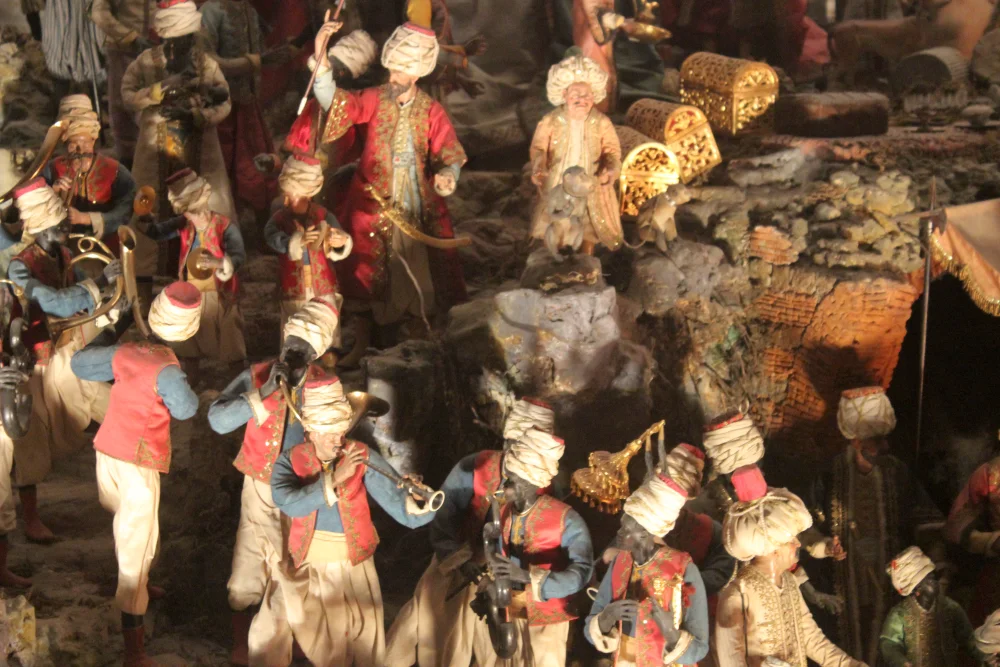
© Miguel Hermoso Cuesta / Wikimedia Commons — CC BY-SA 4.0
The shops on the street sell nativity scenes; to see a large historic display, head up to Vomero. The museum at the Certosa di San Martino holds the presepe Cuciniello, a huge display in an artificial grotto, with hundreds of figures, animals and objects. The display was donated and installed in 1879. Its figures come from different periods, largely the 19th century, continuing the 18th-century tradition.
Afterwards, San Gregorio Armeno's stalls look different: the same bakers, Magi and taverns reappear in the workshops.
A short walk around nativity street
San Gregorio Armeno fits well into a morning in the historic centre. I would start on Via dei Tribunali and Piazza San Gaetano, where you can also visit San Lorenzo Maggiore and its excavations.
Then walk down nativity street, stopping at church and cloister while open. At the bottom, take Spaccanapoli west: Sansevero Chapel hides in a lane just before Piazza San Domenico Maggiore, with Santa Chiara further on. Eastwards, reach Via Duomo, then walk uphill for a few minutes to the cathedral.
Allow thirty to forty-five minutes for the street alone without shopping; 1½–2 hours with the cloister and workshop stops. Fit the morning into a full stay with 3 days in Naples, and find other essential sights in our Naples guide.
For festivities, come early on a December weekday and accept slow progress. For a special purchase, choose October or November. For watching craftspeople work, spring works well. In every season, save the morning for church and cloister, and allow time to study a shepherd's face: that is where the skill shows.
Naples hits you all at once. It is loud and crowded, scooters skim past pedestrians, and some of the world's…
Read more →Beyond Naples' reputation, a practical look at its neighbourhoods: where to stay comfortably, where to be vigilant and which areas…
Read more →