Naples and Amalfi Coast Plug Sockets: Do You Need an Adapter?
Before your first evening in Naples or on the coast, find out which Italian 10A and 16A wall sockets you may encounter so you can charge your devices.
You have just put down your suitcase. Your laptop shows 10% battery. The pins of your bulky charger stop against the wall socket: the spacing and diameter do not match.
Naples plug sockets: which types are used?
Plug sockets in Naples and Campania can bring unexpected practical problems. Southern Italy's electrical installations have been modernised at very different rates between neighbourhoods. If your appliances have UK plugs, bring an adapter suitable for Italian sockets. To plan the rest of your stay, see our Naples travel guide too.
Naples' historic centre and Amalfi Coast villages contain buildings constructed long before electricity reached ordinary homes. Upgrades are often surface-mounted additions made over time, retaining Italy's historic national socket format rather than the modern European style.
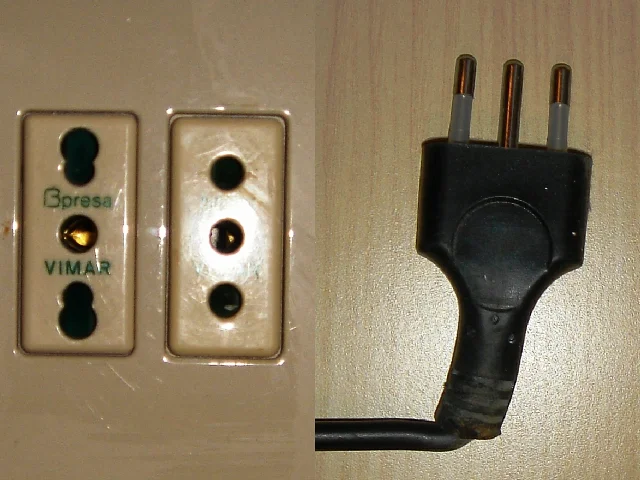
Italy uses three plug standards side by side. Finding different formats in the same room, or even on one wall plate, is commonplace.
© Shoestring / wts.wikivoyage — Public domain
Type L is Italy's traditional socket format. It has three holes in one straight line, either vertical or horizontal. The central pin provides the earth connection, directing fault current to ground.
This format was designed when the country had two separate electricity networks with different tariffs: one for lighting and one for power. It remains widespread in Campania's older buildings.
Type C is the classic European plug with two slim round pins. Some phone chargers, electric toothbrushes and e-readers use it. Its pins are 4 millimetres in diameter. This format fits the great majority of Italian sockets without resistance.
Type F, commonly called Schuko, is the large round plug used for higher-powered appliances. It has two thicker pins, 4.8 millimetres in diameter, and earth contacts on the sides of the socket recess. This modern European format appears on appliance, laptop and hairdryer leads.
Type L 10A or 16A: the catch to know before you travel
Small USB devices are not necessarily the problem; the mains plug matters. Chargers with slim two-pin Type C plugs fit the outer holes of compatible Italian Type L sockets without a plug adapter. A charger with a different plug format needs the appropriate adapter.
Bulky round Type F plugs can cause problems, and Italy's older socket standards add another complication. There are two Type L subtypes that are not physically interchangeable.
| Standard | Hole diameter | Pin spacing | Typical use |
|---|---|---|---|
| Type L 10A | 4 mm | 19 mm | Lamps, chargers and small appliances |
| Type L 16A | 5 mm | 26 mm | Ovens, portable air conditioners and high-power appliances |
| Schuko (Type F) | 4.8 mm | 19 mm (round) | Laptops, hairdryers and European chargers |
If your laptop charger or straighteners have a 4.8 mm Schuko plug, the pins will not fit an old Italian 10A socket. Forcing them in can damage the hotel's plastic socket face and bend your charger pins. The projecting earth pin found in French sockets also has no equivalent receptacle on a flat Italian Type L face.
For appliances with a Schuko plug: an adapter to Italy's three-pin Type L format. Lightweight and useful on your first evening in Naples. Check that the input socket matches your own plug before buying.
Naples plug sockets: what you find in hotels
© Mister No / Wikimedia Commons — CC BY 3.0
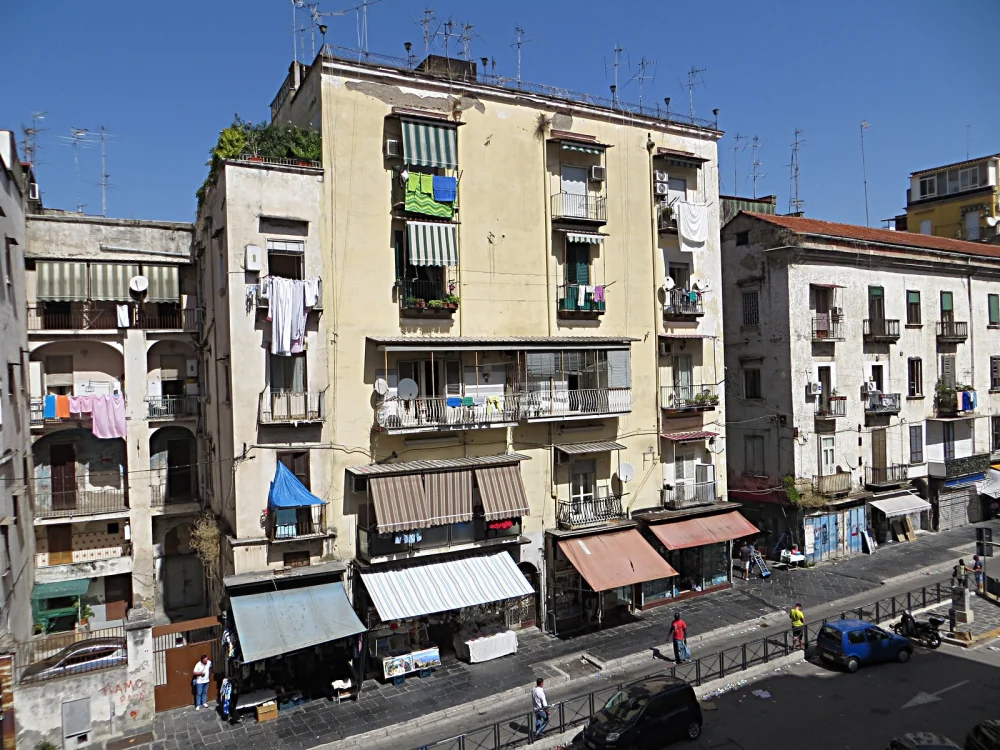
A building's age shapes its wall sockets. In Naples, the huge subdivided apartments around Piazza Garibaldi, the Quartieri Spagnoli's narrow buildings and Rione Sanità's palaces date to the 19th century or earlier.
Volcanic tuff walls can be a metre thick. Completely replacing concealed wiring requires extensive, expensive masonry work.
Owners favour surface wiring hidden in plastic trunking. Boxes mounted above skirting boards often contain only narrow 10-amp Type L sockets. If you are staying several nights in the centre, our 3-day Naples itinerary also helps you choose a practical neighbourhood and reduce journeys.
When booking, open the room's photo gallery on Booking.com and look around the headboard and desk. Surface-mounted boxes with small holes in a line near the skirting board suggest an older installation. Wide round recesses set into the wall suggest modernisation. A quick look helps you decide what to pack.
Amalfi Coast plug sockets: Positano, Amalfi and Ravello
The pattern is even more pronounced on the Amalfi Coast. Positano, Amalfi and Ravello cling to cliffs. Accommodation often occupies former family summer homes, converted monasteries or farm estates in the hills above Sorrento.
A standard room in this kind of property rarely has more than two sockets. One powers a bedside lamp, the other the wall-mounted television. Reaching them often means moving solid wooden furniture.
Bipasso and Schuko: sockets in newer accommodation
Modern hotels and extensively renovated properties now include combined sockets. Campania's electricians install these to accept several Italian and continental European plug formats. These sockets still do not accept every overseas plug.
The Bipasso socket is the first commonly seen upgrade. It retains three aligned holes, but the outer openings are figure-eight shaped. This accepts both slim Italian 10A and thicker Italian 16A plugs. A Type C phone charger fits, but a bulky round Type F laptop plug still does not.
The Schuko-Bipasso, often called universal, solves that particular compatibility problem. It is a large round recessed socket accepting the bulky European plug, with an additional central hole for the Italian earth pin. For those plug formats, no adapter is needed in properties equipped with it.
Naples plug adapters: what to buy and where to find one
Sorting out your electrical connections before boarding avoids an irritating last-minute search after dark.
A simple adapter for a European Schuko plug has three aligned Italian Type L pins on one side and a round European socket on the other. Choose a reputable brand and retailer, check the plug formats and power rating, and do not use an adapter that sits loosely in the wall.
A compact travel charging block with integrated USB ports can be practical. Old Naples guesthouses often hide their only socket behind heavy furniture. A block with a Type L plug lets you charge in one place, with USB and USB-C ports on its face.
© Panek / Wikimedia Commons — CC BY-SA 4.0
If you land at Naples-Capodichino Airport without one, expect to pay extra in the terminal shops: an adapter costing €4 in town can easily cost €15 to €18 at the airport.
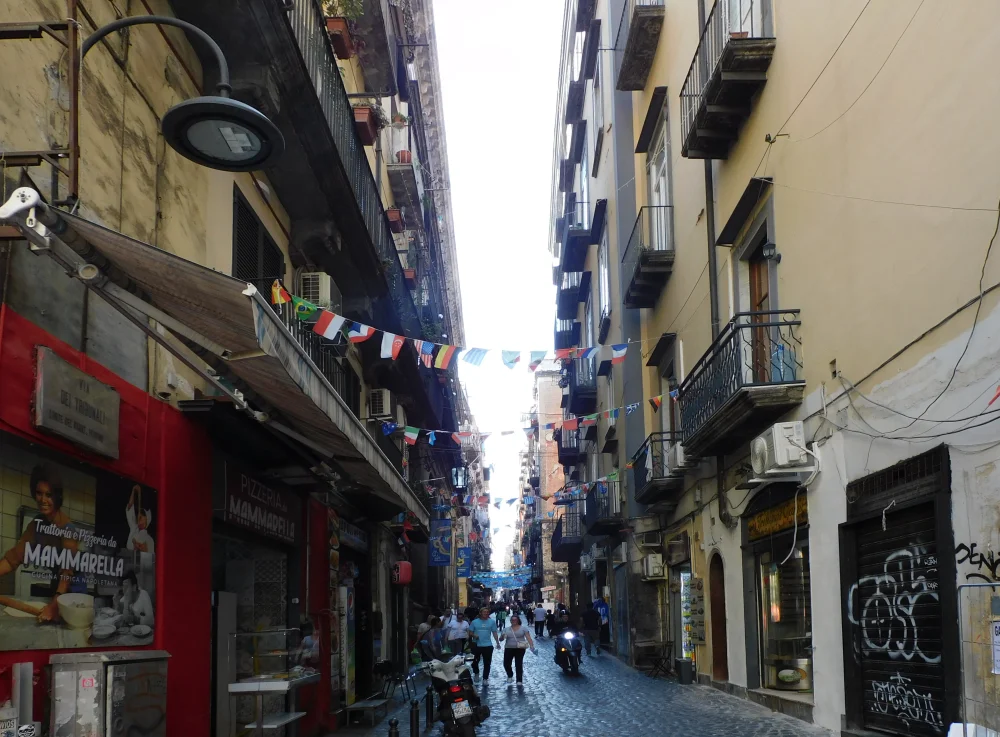
In town, leave the tourist thoroughfares for a neighbourhood hardware shop. Look for 'Ferramenta' signs in lanes off Via dei Tribunali or around Pignasecca market. Show your plug and ask for an adapter for Italian sockets. A basic model costs around €3 to €6.
- Airport shops at Capodichino: €15 to €18, for an urgent replacement only
- Neighbourhood ferramenta shops around Via dei Tribunali and Pignasecca: €3 to €6
- Conad, Sole365 and Carrefour Express supermarkets on Via Toledo: household essentials section, limited stock from mid-June
- Amalfi Coast: hardware shops are scarce, with ground-floor premises mostly devoted to restaurants and summer clothing
Charging devices in a car in Campania
Travellers exploring the region by car have a useful backup. If the old sockets in your Sorrento masseria will not accept your travel adapter, the vehicle can help.
When hiring a car at the airport to follow the SS163 along the Amalfi cliffs, the cigarette-lighter socket becomes a charging station. Pack a powerful 12V USB charger, ideally at least 30W, with two or three ports.
Journeys between Naples, Pompeii and Salerno frequently take over an hour, even over short distances, because of summer coastal traffic. That driving time can restore 50% battery to two phones before your next stop.
Voltage and frequency: do you need a voltage converter?
Italy's electricity supply is 230 V at 50 Hz.
For UK appliances rated for 230 V and 50 Hz, you do not need a voltage converter, but you do need a suitable plug adapter. For equipment bought elsewhere, check its input label: the physical plug and voltage compatibility are separate questions.
If an appliance is designed only for 110 V / 60 Hz, a plug adapter is not enough. Connecting a 110 V-only hairdryer or straightener directly to Italy's 230 V supply can destroy it. Check the rating label: dual-voltage equipment is different. Any required converter must be suitable for the appliance's power rating.
When two people travel with phones, e-readers, smartwatches and cameras, competition for a room's only free socket in Ravello starts around 7pm. I always pack a small three-socket European power strip and a simple Italian Type L adapter. It fits into a small space at the bottom of the case, costs barely €15 and avoids choosing between charging the camera and the phone you will use for navigation on tomorrow's Path of the Gods hike. Match every component to your plugs and device ratings.
From the chaos of Naples' historic centre to Ravello's overhanging terraces: five full days following regional railway lines and the…
Read more →Naples hits you all at once. It is loud and crowded, scooters skim past pedestrians, and some of the world's…
Read more →