Jellyfish on the Amalfi Coast and Capri: Beaches & Practical Tips
Warmer waters bring encounters with Pelagia noctiluca. Understand coastal conditions, choose a base with access to different beaches and know what to do first after a sting.
By late July, the Tyrrhenian Sea often reaches 28°C. The clear water invites an immediate swim, but southerly winds can bring stinging visitors.
Are there jellyfish on the Amalfi Coast? Yes. The question returns every summer in mid-August, when cove pebbles bake in 35°C shade temperatures and the Tyrrhenian Sea reaches 28°C. Stepping into the water brings little change in temperature.
This is the summer warmth people seek in southern Italy. Yet over the past decade, steadily rising temperatures have changed conditions along the Campania coast in August. Swimmers increasingly encounter dense groups of strongly stinging jellyfish.
Making the most of a beach afternoon means understanding how local winds move these groups, choosing a practical base and knowing what to do after a sting, rather than relying on folk remedies.
Why are there jellyfish in Campania?
The species causing trouble around Naples has a name: Pelagia noctiluca, the mauve stinger. It is small, with a bell rarely exceeding ten centimetres across, and ranges from pale pink to vivid violet.
Unlike some larger, relatively harmless Mediterranean species, such as the brown-and-yellow fried-egg jellyfish, Pelagia can cause severe stings. Its tentacles are almost invisible underwater and may trail one or two metres behind its body.
Winds and currents help bring jellyfish towards beaches. Pelagic jellyfish drift with the current rather than swimming against it. Offshore winds push the surface water away from land, which can make nearshore water cooler and reduce jellyfish concentrations.
Onshore winds, by contrast, can push offshore groups towards the coast. In Campania, the Scirocco is a frequent culprit: a hot, humid south-easterly wind. After two or three days, it can carry large numbers of Pelagia noctiluca towards south-facing shores. Small violet shapes then drift just below the surface.
Jellyfish around the Amalfi Coast, Capri and Ischia: exposed areas
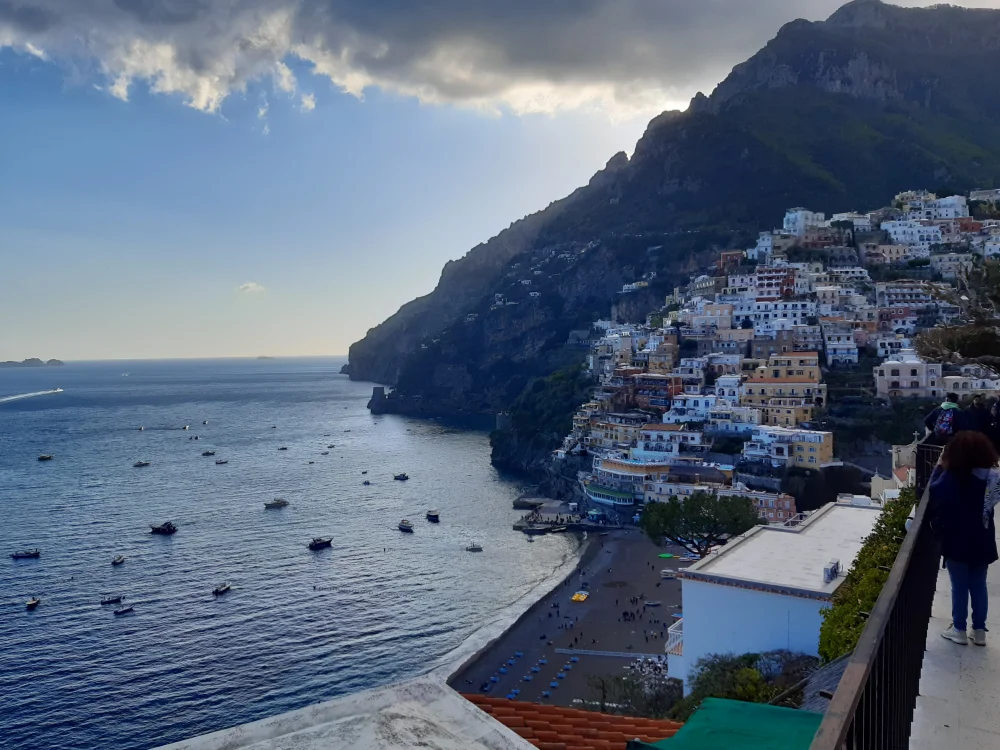
Campania's indented coastline creates natural traps for jellyfish. The Amalfi Coast faces south, taking currents driven by the Scirocco head on. Its enclosed coves can hold them near shore.
In Positano, jellyfish regularly gather at Spiaggia Grande or neighbouring Fornillo after onshore winds. Fiordo di Furore, a narrow gorge crossed by a stone bridge thirty metres above, can trap them. Once inside, they may remain until changing winds create an outward current.
© Wiki.Bianco / Wikimedia Commons — CC BY-SA 4.0
Offshore, jellyfish in the Bay of Naples follow a similar weather pattern. The limestone cliffs of Capri, particularly the southern side around the Faraglioni and Marina Piccola, can see rapid accumulations as currents change. Planning your day flexibly helps.
Large shared excursion boats, charging around €85–120 per person from Naples or Sorrento, follow fixed itineraries. If they reach an affected spot, the captain may cancel the swimming stop. A small private boat offers more flexibility. A local skipper can adapt the route as conditions change: if the south coast is unsuitable, they can try the northern side towards Bagni di Tiberio, looking for a sheltered cove with clearer water.
Ischia and Procida are no exception. On Ischia, the long south-facing Maronti beach is exposed to the Scirocco. If violet dots appear in the water, consider the north-west around Forio or Baia di Sorgeto. This rocky cove, known for thermal springs entering the sea, is often less exposed to major surface currents, although the water can reach 35°C.
On Procida, Chiaiolella's black-sand beach follows similar patterns: check the wind before hiring sunbeds. To choose between the three islands by season, our Capri, Ischia and Procida comparison explains transport and visitor numbers.
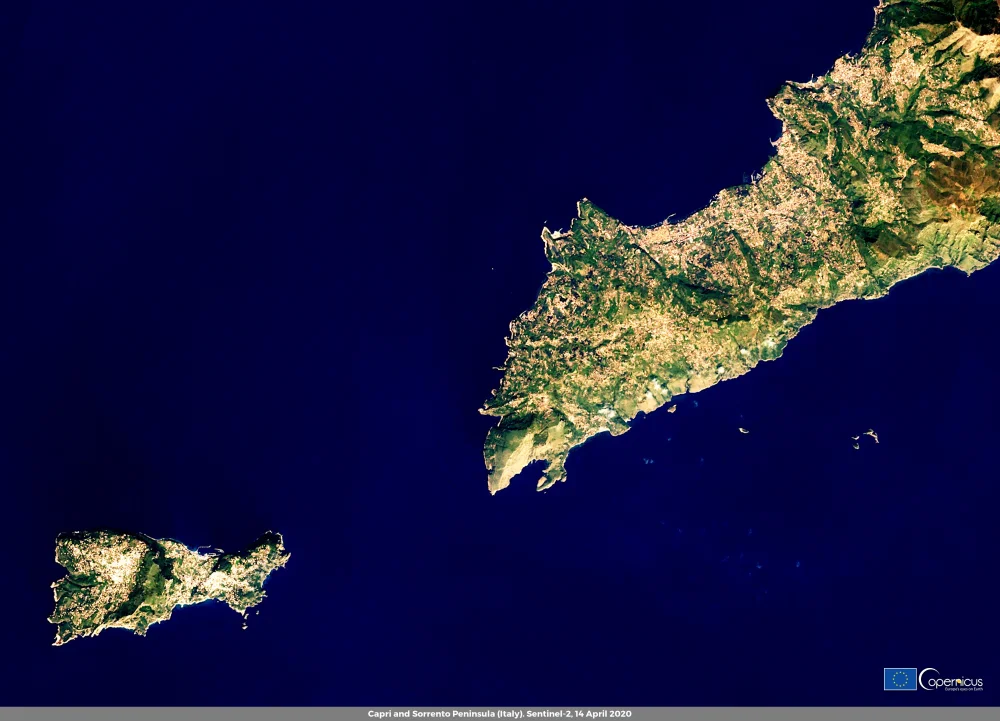
On the mainland, the Sorrento peninsula offers an alternative. This thirty-kilometre arm of land acts as a natural barrier between two bodies of water: the Bay of Naples to the north and Gulf of Salerno to the south.
The two sides can experience different conditions. When winds push jellyfish onto northern beaches at Meta di Sorrento or Vico Equense, the mountain may shelter the southern coast.
© European Union, Copernicus Sentinel-2 imagery / Wikimedia Commons — Attribution
To use this flexibility, you need transport. A car booked at Naples airport provides independence. From central Sorrento, follow Via Nastro Verde as it winds uphill among olive and lemon trees, crosses the ridge and descends south.
After around 35 minutes, you reach Marina del Cantone's pebble beach in Nerano. Changing sides of the peninsula may bring clearer water, but check local conditions before swimming. To compare hire prices on arrival, view Naples airport deals on Rentalcars.
Where to stay for access to both bays
The Sorrento peninsula's geography makes it easier to try a different coast when conditions change, provided you choose a practical base. Many visitors stay in central Sorrento, on a cliff above the sea on the peninsula's northern side, with few places to reach the water directly.
An alternative is Sant'Agata sui Due Golfi, on the ridge. As its name suggests, the village overlooks both gulfs. Look for a guesthouse or small B&B with parking included. Allow €90–140 a night in high season.
Mornings are straightforward. Have coffee in the village square, check the wind direction or local groups, then take the car. A fifteen-minute drive downhill to the north takes you to Sorrento's beaches. Fifteen minutes south brings you to Nerano's pebbles or the start of the Baia di Ieranto trail. You have more choice over which side of the peninsula to try.
How can you find out whether there are jellyfish today?
Before paying €40 for two sunbeds and a parasol for the day, check the water. Reporting apps and scientific websites may not reflect conditions in real time. Advice on the beach and from the local community is useful.
Start with the bagnino, the lifeguard. Often wearing a red T-shirt, on a raised chair or arranging parasols from 8am, they inspect the water before most visitors. Speak to them before paying at the lido. Ask: 'Ci sono meduse oggi?' — 'Are there jellyfish today?' They can tell you whether any have been seen, and whether they are offshore or near the beach.
Another option is local Facebook groups. Look for names such as Sei di Sorrento se... or information pages for Positano and Amalfi. From 9am in summer, residents post sea photographs and current weather updates. A clear-water photograph captioned 'Mare pulito a Nerano oggi' — 'Clear sea in Nerano today' — is useful local information, though conditions can change.
What to do after a jellyfish sting
Contact with Pelagia noctiluca tentacles can cause sudden, intense pain, combining a sharp electric sensation with burning. Red, swollen lines can appear within a minute, following the tentacle's path across an arm or leg.
Avoid improvised remedies: do not rinse the area with fresh water or urinate on the sting. For a sting attributed to Pelagia noctiluca, seawater is a cautious rinsing option; experimental research indicates that vinegar can trigger nematocyst discharge in this species, so it is not a universal remedy. If the species is unknown, ask the first-aid post before applying a product.
Move away from jellyfish and reach shore without sudden movements. If the pain comes with faintness, breathing difficulty, marked swelling or symptoms affecting the whole body, alert the first-aid post immediately or call 112.
Gently rinse the area with seawater to remove loose fragments. Avoid fresh water, which can encourage intact nematocysts to discharge.
If strands remain on the skin, gently remove them with fine tweezers or protected hands. Avoid vigorous rubbing or handling tentacles with bare hands.
If possible, immerse the affected area in comfortably hot water, around 42–45°C, for about 20–30 minutes or until pain clearly eases. Avoid hot sand and uncontrolled heat sources, which can burn the skin.
Look for the green cross of a Farmacia and explain that it is a jellyfish sting: 'Ho bisogno di qualcosa per una puntura di medusa'. Depending on your skin and medical history, the pharmacist can suggest appropriate symptom relief or direct you to a doctor. Seek prompt medical advice if pain stays severe or the reaction spreads.

© Андрей Романенко / Wikimedia Commons — CC BY-SA 4.0
Find the nearest first-aid post or pharmacy, and ask the bagnino about water conditions before settling in. After a sting, remember three basics: get out of the water, rinse with seawater and avoid improvised remedies. Small tweezers in your beach kit can help remove a visible strand without touching it directly.
Seven days in southern Italy, from Naples' urban energy to the Amalfi Coast's steep cliffs, through Pompeii's ash and the…
Read more →Three islands reached from Naples' port. Each needs a different budget and a different travel plan.
Read more →