Scanno: village walks and the heart-shaped lake
Between medieval lanes and a heart-shaped lake, this village in the Sagittario Valley inspired Cartier-Bresson and continues to draw photographers.
In 1951, Henri Cartier-Bresson visited Abruzzo and made one of Italy’s best-known 20th-century photographs, now at New York’s MoMA. Its stone setting is Scanno.
Scanno’s historic centre: lanes, stone houses and cemmause stairways
Scanno takes some effort to reach. Perched at 1,050 metres in the upper Sagittario Valley, in the province of L’Aquila, the village rewards a winding drive. For car hire to explore Abruzzo, use Rentalcars to compare available vehicles and prices.
The approach from Sulmona via the SR479 gives a sense of the village’s isolation. The road narrows through dimly lit rock-cut tunnels and follows cliffs above the Sagittario River. After around thirty minutes of climbing, a compact town appears, designed to hold winter warmth and shelter from sharp mountain winds.
© Angelorenzi / Wikimedia Commons, CC BY-SA 4.0
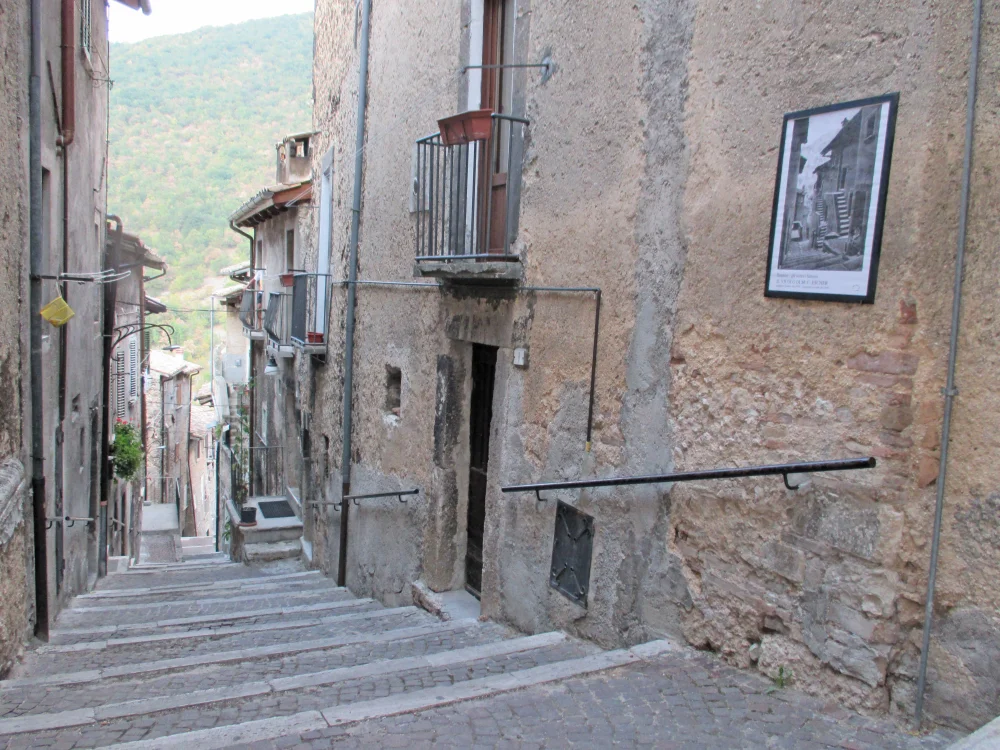
The old centre keeps its medieval layout. There is little level ground: cobbled lanes climb and descend steeply beneath stone arches linking the façades and bracing the buildings against earthquakes.
Look for the cemmause, Scanno’s characteristic pale-stone outdoor staircases. They rise from the street to first-floor living rooms, above vaulted, often windowless ground floors once used as stables or workshops.
Carved coats of arms sit above solid wooden doors. They recall the prosperous 17th and 18th centuries, when wealthy sheep-farming families built imposing palazzi.
That wealth came from transhumance. Every autumn, millions of sheep left these mountains for Puglia’s milder plains. Scanno’s baroni invested the proceeds in the village’s stone buildings.
Park below and continue on foot: cars stay outside the old centre. Light barely reaches the narrowest lanes, casting sharp shadows across cobbles polished by centuries of footsteps.
Why has Scanno attracted so many photographers?
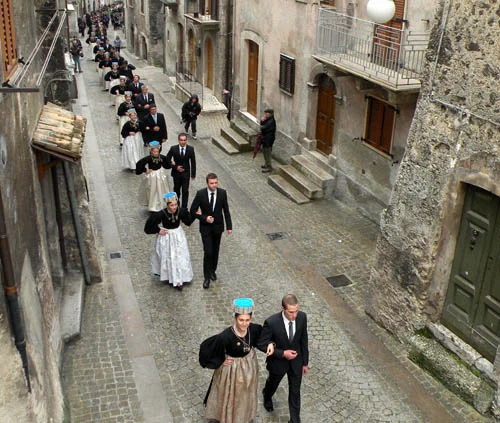
Scanno’s modern history was written in the darkroom. When Henri Cartier-Bresson arrived in 1951, southern Italy was still recovering from the war. His photograph of women in traditional dress helped draw other photographers to the same steep lanes, including Mario Giacomelli, Gianni Berengo Gardin and Germany’s Hilde Lotz-Bauer.
© Archivio Sergio Paolo Sciullo della Rocca / Wikimedia Commons, Attribution
The photographers came for the people as well as the buildings. For centuries, men spent nine months a year following flocks south, leaving women to run households and much of the village economy.
This independence went alongside a distinctive local women’s costume, one of Italy’s best preserved.
Scanno’s traditional dress is austere and deep black, coloured with natural dyes. The wide gonna skirt uses several kilos of tightly spun local wool, while the bodice is a structured corpetto. Women wear a distinctive turban-shaped headdress suited to the mountain cold.
In the black-and-white photographs of the 1950s, dark figures stand out against whitewashed arches.
A few older women still wear the dress in everyday life. Around 07:30, you may see them buying bread or going to Mass. Smartphones have replaced Leicas, but the late-afternoon light on the stone walls still rewards a careful eye.
Scanno souvenirs: presentosa jewellery and bobbin lace
Scanno’s isolation fostered meticulous local crafts. Its goldsmiths’ best-known piece fits in a palm: the Presentosa, a filigree gold star with one or two hearts at its centre.
The groom’s parents gave a Presentosa to the bride-to-be at her engagement. Worn on the chest, it signalled that she was promised to someone and waiting for her fiancé’s return from transhumance. Goldsmiths draw the gold into wire a tenth of a millimetre thick before twisting and soldering the filigree.
Other dowry jewellery included circejje, long drop earrings decorated with pearls or coral. Inside the shop, watch the goldsmith work with pliers and a torch at the bench. An 18-carat gold Presentosa requires hours of careful work.
- Address: Oreficeria Di Rienzo, Via De Angelis 1, Scanno
- Founded in 1850; now run by Armando, Giuseppe and Eugenio Di Rienzo
- Prices: from €80 for silver pieces; several hundred euros for a gold filigree design
The other great local craft is bobbin lace. In warmer months, the dry click of wooden bobbins can be heard on doorsteps. Tombolo lace is made on a straw-filled cylindrical cushion, with dozens of threads worked together into table linen or clothing trims. Local makers use fine linen thread and favour precise geometric patterns.
How to see Lake Scanno’s heart shape
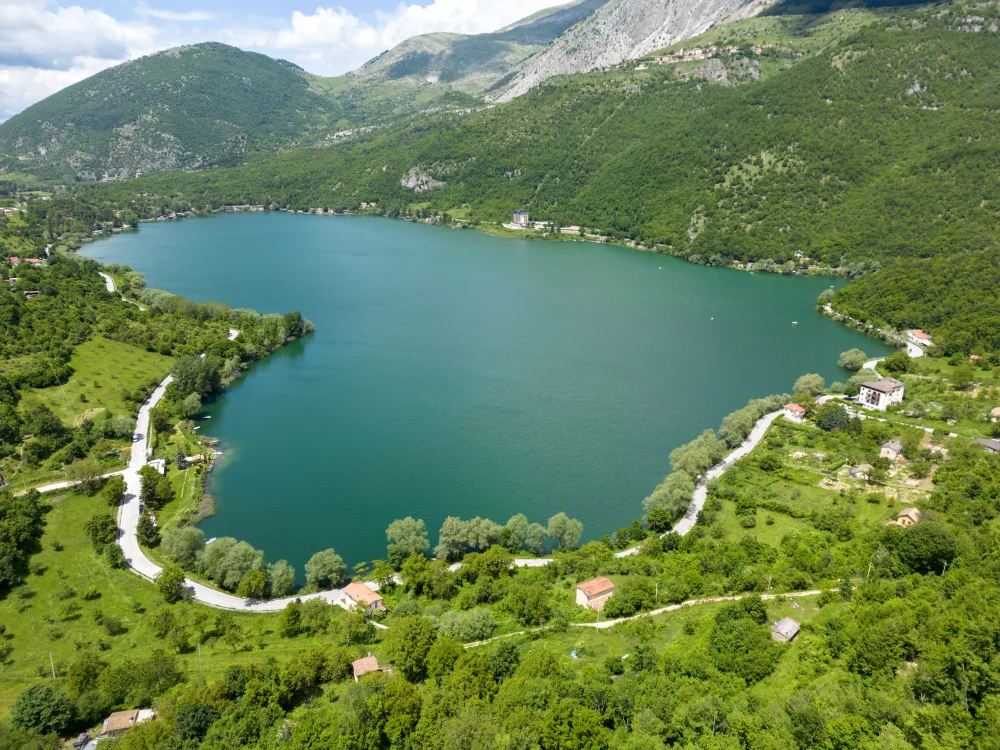
Five minutes’ drive downhill from the village, Lake Scanno is Abruzzo’s largest natural lake. It formed when a landslide from Monte Genzana blocked the Tasso River. Its deep-green waters attract summer bathers and trout anglers through the rest of the year.
From the shore, the heart shape is hidden. To see it, you need to climb above the lake.
The Sentiero del Cuore starts near the shore. Coming from Villalago, use the car park beside the SR479. The dirt path climbs steeply in places and gets slippery after rain: wear walking shoes or trainers with good grip.
The trail climbs through trees and passesEremo di Sant'Egidio, a small 17th-century stone hermitage.
© Fiat 500e / Wikimedia Commons, CC BY-SA 4.0
After 30–45 minutes uphill, you reach an open, level viewpoint. From this angle, the shoreline, perspective and surrounding hills combine to give the lake its familiar heart shape.
Go up around noon, when sunlight reaches the valley floor. Later in the year, the lake can fall into the mountains’ shadow from 16:00.
Around Scanno: the Sagittario Gorge and Abruzzo National Park
Follow the mountain road north for open views, stopping at Villalago, a medieval village on a rocky spur above Lakes San Domenico and Pio.
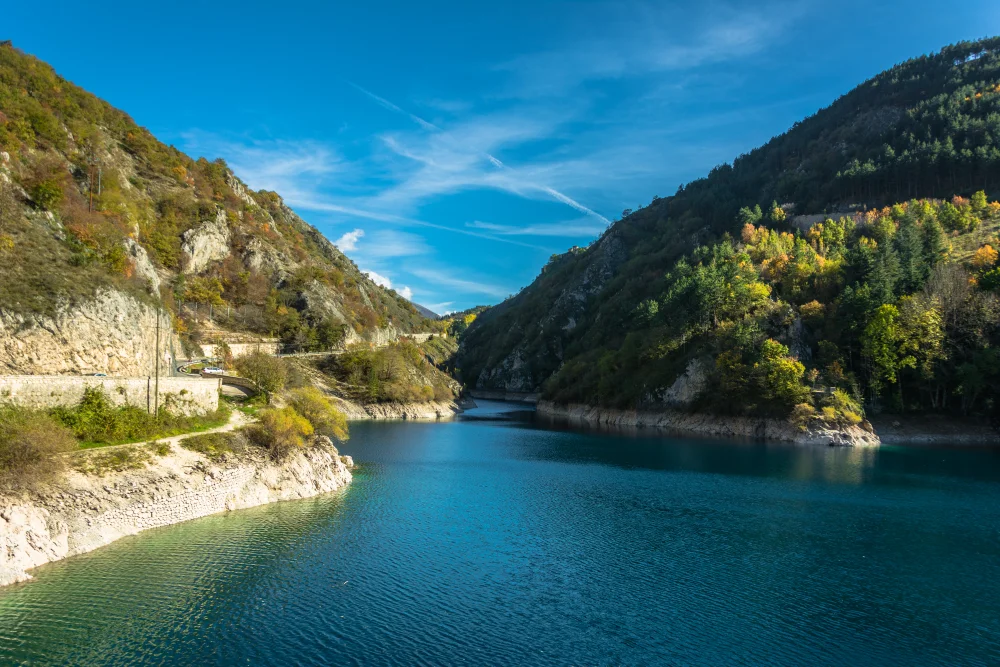
Beside Lake San Domenico standsEremo di San Domenico, a hermitage tucked into the cliff above green water. Cross the stone bridge to reach the cool, damp rock: it gives a sense of the seclusion sought by 11th-century monks.
© Fabio Ciminelli / Wikimedia Commons, CC BY-SA 4.0
Continuing downhill towards Sulmona brings you to the Gole del Sagittario nature reserve. The river has cut a narrow white-limestone canyon beneath vegetation-covered cliffs.
Use the roadside stopping areas to look into the gorge from above.
In the other direction, cross Passo Godi south of Scanno towards Villetta Barrea and Pescasseroli. You enter Abruzzo, Lazio and Molise National Park, home to Marsican brown bears and Apennine wolves. Allow 45 minutes of winding roads to reach Pescasseroli.
Where to eat in Scanno : arrosticini, chitarra and local cheeses
At 1,050 metres, meals draw on hearty shepherds’ cooking. Order arrosticini by the dozen.
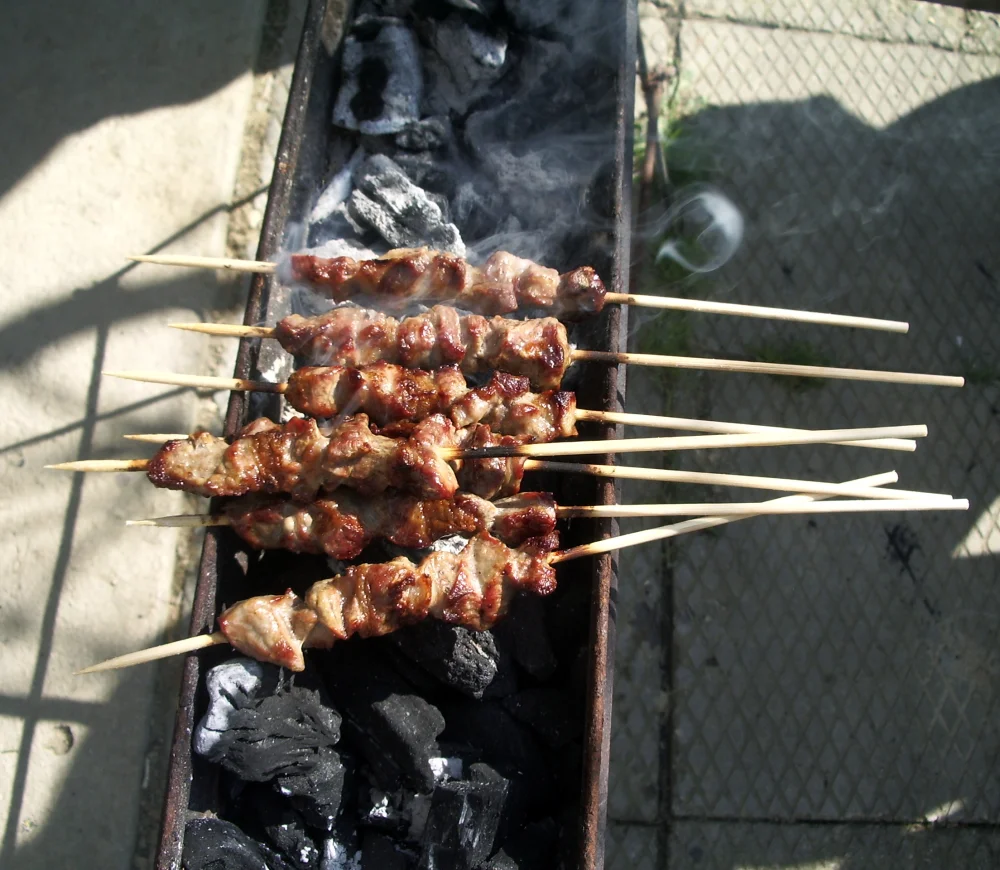
© Stefano Delle Monache / Wikimedia Commons, CC BY-SA 3.0
These small mutton skewers cook over embers on narrow grills called canaline. Eat them with your fingers, enjoying the smoky flavour of the rendered fat.
For maccheroni alla chitarra, thick pasta dough is pressed through steel wires stretched over a wooden frame. The square strands hold a rich mutton ragù well.
For a straightforward meal, tryAntica Trattoria Via Roma, at number 13. The room is lively, service straightforward and meat cooked in view. Book several days ahead for weekends; it is often full and closes on Wednesdays. Allow €25–30 for a full meal.
For cheese, drive towards Passo Godi. Around 5 km out, Bio Agriturismo Valle Scannese da Gregorio is the dairy associated with producer Gregorio Rotolo. Inside the caseificio, the strong aromas of the cellar and raw sheep’s milk fill the air. Leave with an aged pecorino or ricotta freshly made that morning: allow €40–55 per kg, depending on maturation.
Before leaving the village, stop at the Pasticceria Di Masso. The family created Pan dell’Orso in 1945: a dense, domed cake flavoured with mountain honey and toasted almonds, beneath a thick dark-chocolate shell. Allow around €15 a cake, depending on size.
Where to stay in Scanno
Stay in the historic centre for early photographs of its quiet lanes, with low light on the stone around 06:00. Accommodation is limited: book at least two months ahead for peak season.
- , in a historic-centre building, with wrought-iron beds and antique furniture
- Breakfast buffet available all day
- Several flights of stairs, without a lift
- Allow around €85 a night. Book on Booking.com
- Free private parking, around 1 km from the lake and Sentiero del Cuore trailhead
- Family-run restaurant serving generous local dishes
- Away from the historic centre: allow for a short walk or a drive in the evening
- Allow €65–100 for a double room, depending on the season. Booking.com
Seven days from Abruzzo’s coast to its mountains: Adriatic fishing platforms, a castle set among vineyards, Ovid’s home town, one…
Read more →Climb from the stone village to the towers seen in Ladyhawke, passing narrow lanes, a small octagonal church and wide…
Read more →