Rocca Calascio: visiting the Ladyhawke castle
Climb from the stone village to the towers seen in Ladyhawke, passing narrow lanes, a small octagonal church and wide mountain views across Abruzzo.
At Rocca Calascio, the castle's outline is the main draw, but the walk begins well before the towers. Explore the lanes, octagonal church and mountain views, then plan your climb, photographs and a stay in the surrounding villages.
What to see at Rocca Calascio
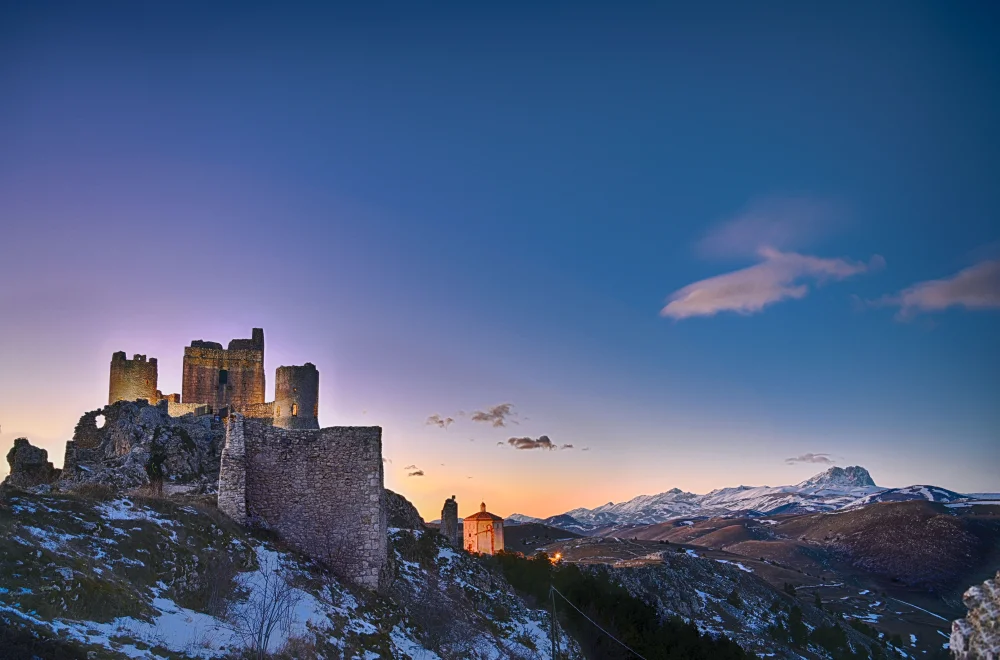
The castle, the octagonal church of Santa Maria della Pietà and the small stone village make up a visit to Rocca Calascio. At 1,460 metres, the setting is reason enough to climb: four towers on a pale ridge, layers of mountains and a wide-open sky.
I would allow half a day if walking up from Calascio, or around two hours for the upper village and castle. Come for the climb, the ruins and time to look across the mountains, rather than a succession of furnished castle rooms.
© Rabih omeiri / Wikimedia Commons — CC BY-SA 4.0
The upper village: lanes below the towers
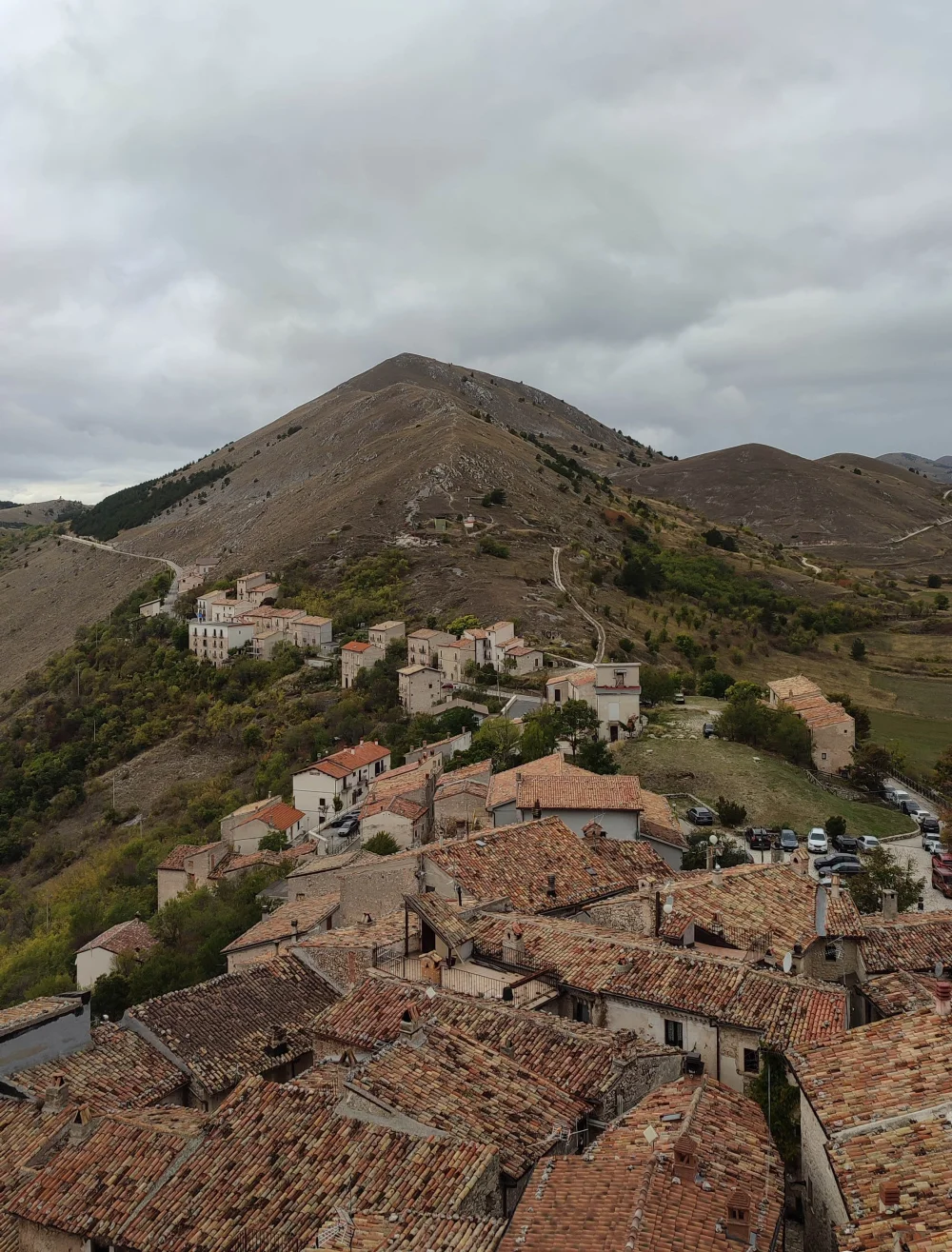
The village of Calascio is below; the village of Rocca Calascio lies further up, below the fortress. This distinction matters for both getting there and planning your walk. Explore the lanes between the houses before joining the path: their close walls make the open plateau feel all the more striking.
The village is no longer completely abandoned. Houses have been restored and businesses have reopened, while the ruins recall its turbulent past. I would take time to explore these few streets rather than head straight to the castle viewpoint.
The fortress and the panoramas
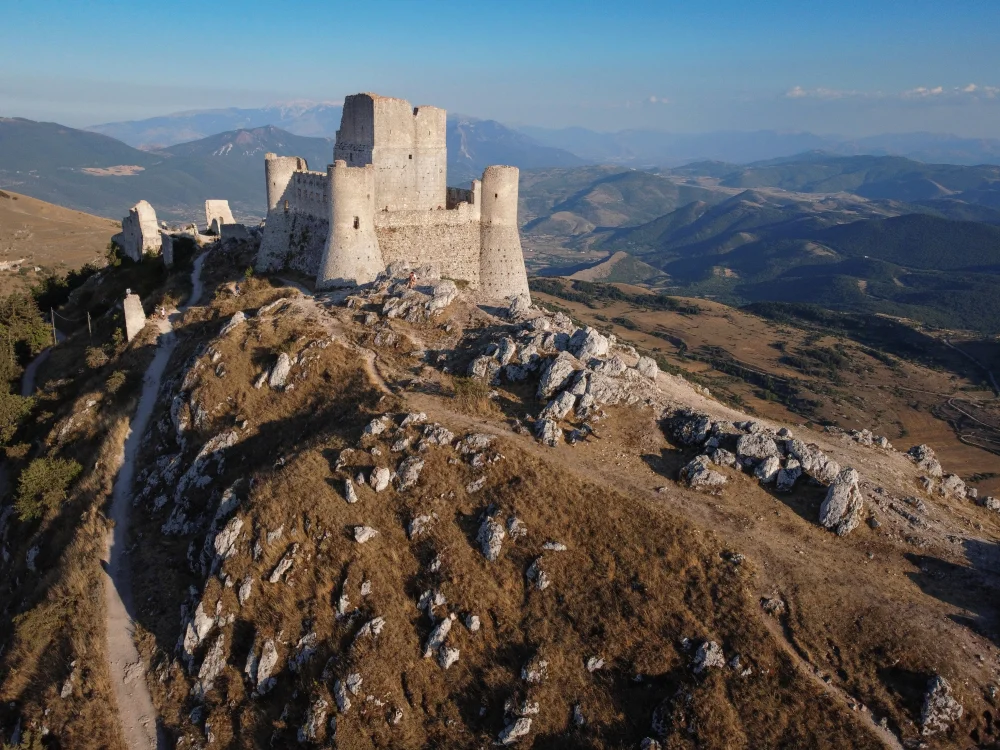
Four round towers surround the central keep. The white limestone seems to grow out of the rock beneath it. Looking up from the path, you can understand the site's role as a lookout without needing a long list of its former lords.
In clear weather, the views take in Gran Sasso, the Navelli plain and the Tirino valley. Follow the open paths around the ruins and enter the tower when access is permitted. The view from the surroundings is already a large part of the visit.
Santa Maria della Pietà, the small octagonal church
© Pietro / Wikimedia Commons — CC BY-SA 4.0
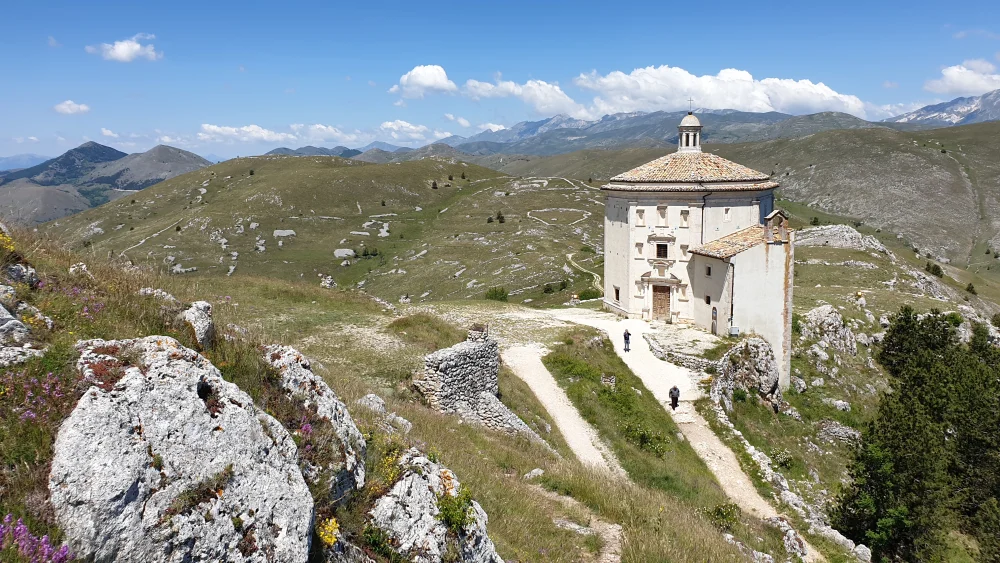
Before the final climb, the church stands on the plateau. Its eight sides and dome contrast with the castle's damaged towers: two very different outlines in the same landscape.
Built in 1596, it is traditionally linked to a local victory over brigands. It is worth the detour even when closed. Step inside if it is open; otherwise, walk a little further to see how it sits below the fortress.
Access, parking and shuttle
Calascio → upper village of Rocca Calascio → church and castle. Keep these three levels in mind: the shuttle stops below the towers, and even driving leaves a final uphill walk.
| Your option | To the upper village | Then to the church and the castle |
|---|---|---|
| On foot from Calascio | Around 40 minutes via the old mule track | 10 to 15 min walk |
| Walking along the road | Around 1 hour along the 3 km uphill road | 10 to 15 min walk |
| With the shuttle | From Calascio, on operating dates | Final stretch on foot through the upper village |
| By car, when access is permitted | Use available parking spaces at the top | Final stretch on foot through the upper village |
Where to park in Rocca Calascio?
At busy times, the road up from Calascio may be closed to unauthorised vehicles. Follow the parking instructions in Calascio, then choose the shuttle or walking route. Piazza della Repubblica is the departure point, not a guaranteed parking space.
When driving is permitted, parking at the top is still limited. I would not count on finding a space late in the day. Restriction dates vary: follow current signs rather than assuming unrestricted access throughout the quieter months.
The Calascio shuttle in 2026
The service does not run every day throughout these four months. Check the Vivi Calascio calendar before choosing a date, and confirm the last return departure.
Castle admission and opening hours
Walking through the village and around the castle is separate from entering the central tower. The cooperative advertises admission by voluntary donation, from 09:00 until sunset, conditions permitting. The interior is therefore not accessible around the clock.
Before climbing up to visit the tower, check the visitor information. The cooperative also reports that its short “tower and ruins” guided tour is suspended during excavations . This does not mean the entire site is closed, but confirm which parts are accessible.
How long to allow and a suggested route
I would allow around two hours from the upper village for the lanes, church, ruins and photo stops. If walking both up and down from Calascio, allow 3-4 hours. The shuttle reduces the climb, but waiting time still needs to be factored in.
Start with the stone lanes. The fortress is above you; stay on the established route rather than cutting across the slopes.
The church makes a rewarding first stop. Enjoy the panorama before walking the final stretch to the towers.
Explore the paths that are open, then enter the tower if access is permitted. On a clear day, it is easy to linger longer than planned.
Return along the access path. Coffee in the village or lunch further down makes a better next stop than squeezing in another hurried visit.
An independent visit suits those mainly interested in walking and the views. A guided outing adds village history and a planned route. Check the ascent, meeting point and actual places included, as well as the castle photograph.
The castle from Ladyhawke
© D.belfiore / Wikimedia Commons — CC BY-SA 4.0
Ladyhawke, released in 1985, helped make Rocca Calascio famous. Richard Donner’s film, starring Rutger Hauer and Michelle Pfeiffer, found a ready-made medieval setting in its stone and windswept mountains.
The outline is instantly recognisable. Even if you have not seen the film, a look at the towers from the path explains their appeal to filmmakers.
Before cinema, wool and transhumance
The fortress once overlooked a busy pastoral landscape. Flocks descended from Abruzzo mountains to winter pastures in Puglia along the routes of the transumanza, the seasonal movement of livestock. The wool trade made this territory valuable.
The Piccolomini strengthened the fortress in the 15th century; the Medici later entered this history of land and wool. Decline after the 1703 earthquake was gradual, rather than a sudden abandonment. The village’s revival began before the filming of Ladyhawke, which brought it wider recognition.
Film fans will find other locations around Castel del Monte and Campo Imperatore associated with The Name of the Rose and The American. They can form part of the same Abruzzo trip, but they are not necessarily the same buildings or plateau.
When to visit and photograph Rocca Calascio
I would choose the morning for a walk followed by lunch, or late afternoon for the light on the towers. Walking a little way back down towards the church brings its dome into contrast with the castle's broken outline. Stay on accessible passages: no photo justifies climbing on a wall of ruins.
At sunset, the limestone can turn orange as the valleys darken. The effect depends on the sky rather than a precise minute on a clock. Leave time to watch the light change instead of arriving at the last moment.
The 2026 shuttle timetable ends at 19:00. Summer sunset can be later, so do not rely on a bus after your photographs. Plan the descent and bring a head torch and warm clothing. Leave before dark if you want to walk down in daylight.
May, June, September and October are the months I would consider first. A fine Sunday can still be busy outside summer. In July and August, choose your arrival time and plan access carefully; in winter, snow and ice can completely change the climb.
Wear shoes with good grip and bring water, sun protection and a windproof layer. The final path is stony and exposed. Keep children close near the ruins; if the weather looks threatening, save the castle for another day.
Where to stay and explore next
One night in the area avoids taking a long road after the evening photos. Calascio allows you to stay close to the climb; Santo Stefano di Sessanio, around a twenty-minute drive from the lower village, adds another rewarding stone village to the trip.
© Gabriella Pesce / Wikimedia Commons — CC BY-SA 4.0
In Santo Stefano, covered passages and closely packed houses invite you to leave the car until the next day. The village deserves more than a bed for the night after visiting the castle.
This is where Sextantio developed its albergo diffuso : a hotel with rooms spread across old village houses. Step outside your room into a real lane rather than a hotel corridor.
Sextantio: sleeping in the houses of the village
Daniele Kihlgren's project retains the stone, small windows and character of traditional rural interiors. Its appeal lies in their simplicity, rather than added mountain-chalet decoration.
Allow around 240 € per night, and sometimes more than €300 during popular periods. Reception is on Via Principe Umberto. Ask for luggage instructions before you enter the small streets.
Residence Il Palazzo: another place to stay nearby
For a lower budget, Residence Il Palazzo occupies a former 17th-century coaching inn at Via G. D’Annunzio 12. The address offers rooms and apartments, with a restaurant on site. Keep a budget around 90 € per night.
Where to eat after the visit?
I would save room for a soup made with lenticchie di Santo Stefano di Sessanio. These tiny, dark lentils, recognised by a Slow Food Presidium, grow in the Gran Sasso uplands. A simple preparation with olive oil and bread makes a satisfying meal after the walk.
Il Palazzo's restaurant is one option for regional cooking; in the village, Cibo in Cima Al Centro also serves local dishes. Book dinner when arranging your overnight stay, especially outside peak season, so you are not searching for a table after the descent.
What to see around Rocca Calascio?
Santo Stefano, Castel del Monte and Campo Imperatore offer ways to extend your stay. Choose according to the time available rather than fitting every village in after the walk. Our one-week Abruzzo itinerary helps you divide your time between the mountains and coast.
For another day dedicated to fortresses, Civitella del Tronto offers a very different layout: a long stronghold above its village, compared with Rocca Calascio's compact outline and four towers. It is a separate excursion, rather than a nearby stop to squeeze in.
Frequently asked questions
How long does it take to visit Rocca Calascio?
Is the entrance to the castle free of charge?
Can you drive up to Rocca Calascio?
Is Rocca Calascio suitable for children or a pushchair?
Can we come with a dog?
Can we stay for sunset?
Seven days from Abruzzo’s coast to its mountains: Adriatic fishing platforms, a castle set among vineyards, Ovid’s home town, one…
Read more →Between Ortona and Vasto, three-century-old wooden fishing platforms have become some of Abruzzo’s most sought-after places for a seafood meal.
Read more →