7 days in Abruzzo: from the Costa dei Trabocchi to Gran Sasso
Seven days from Abruzzo’s coast to its mountains: Adriatic fishing platforms, a castle set among vineyards, Ovid’s home town, one of Italy’s most beautiful villages and a night beneath Gran Sasso.
Few Italian regions let you sleep beside the sea one night and at 1,250 metres five days later. This week-long route links the Costa dei Trabocchi, Peligna Valley and Gran Sasso. Each night brings a different place to stay, from a simple B&B to Sextantio, a celebrated albergo diffuso.
One week in Abruzzo: the itinerary, day by day
- 1PescaraFascist-era architecture and dinner by the sea
- 2Costa dei Trabocchi · VastoWooden fishing platforms and an abbey overlooking the Adriatic
- 3CasacanditellaA nature reserve in the morning, a wine estate in the evening
- 4SulmonaMedieval aqueduct and sugared almonds since 1783
- 5PescocostanzoWrought-iron balconies and Apennine chamois
- 6Campo Imperatore · Santo StefanoGran Sasso's high plains and a medieval village
- 7L’AquilaBasilica and Fountain of the 99 Spouts before heading home
Day 1 · Pescara · Arrival in Pescara: the seafront and Pescara Vecchia
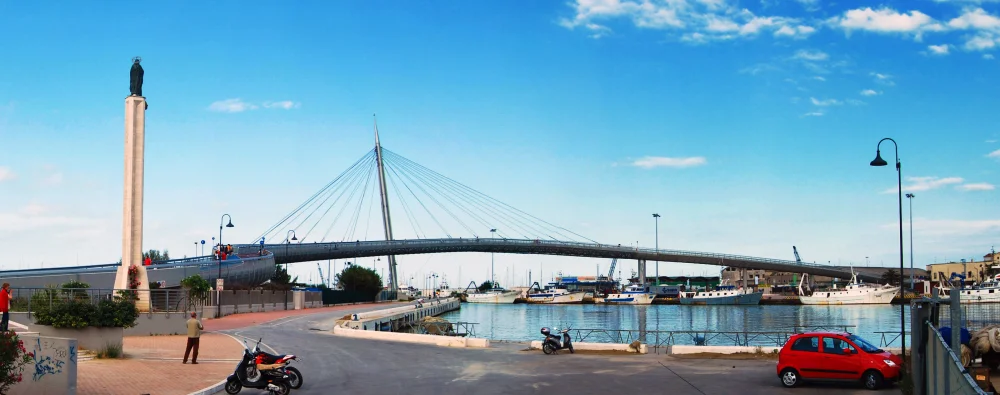
Le Ponte del Mare, à l'embouchure du fleuve Pescara. © Exephyo / Wikimedia Commons · CC BY-SA 3.0
Abruzzo Airport is five kilometres from central Pescara, less than fifteen minutes by car. Car hire desks are in the arrivals hall; compare rates on Rentalcars . Parking near the seafront costs around 1.20 € per hour.
Pescara was largely rebuilt during the Fascist era and after the Second World War. Its grid layout makes driving straightforward; park at your hotel or in nearby streets.
Start in Pescara Vecchia. Corso Manthonè contains much of the city's surviving history. At number 111 is Gabriele D’Annunzio's house, with admission costing 5 € : 19th-century furniture, frescoes on the ceiling, first manuscripts of the writer.
A few dozen metres away, San Cetteo Cathedral houses D’Annunzio's mother's tomb. The writer helped fund much of its construction in the 1930s.
In late afternoon, walk to Ponte del Mare, a footbridge stretching 466 metres spanning the mouth of the Pescara River. From the top, you can see the first wooden trabocchi along the south pier, with the Majella peaks behind them.
Dine along Lungomare Matteotti. Beach restaurants serve fritto misto and spaghetti with clams for around €20.
- 15:00D’Annunzio's houseCorso Manthonè, admission €5.
- 18:30Ponte del MareView of the first trabocchi at sunset.
- 20:00LungomareFish dinner in a lido.
Day 2 · Costa dei Trabocchi · Vasto · Costa dei Trabocchi: lunch over the Adriatic
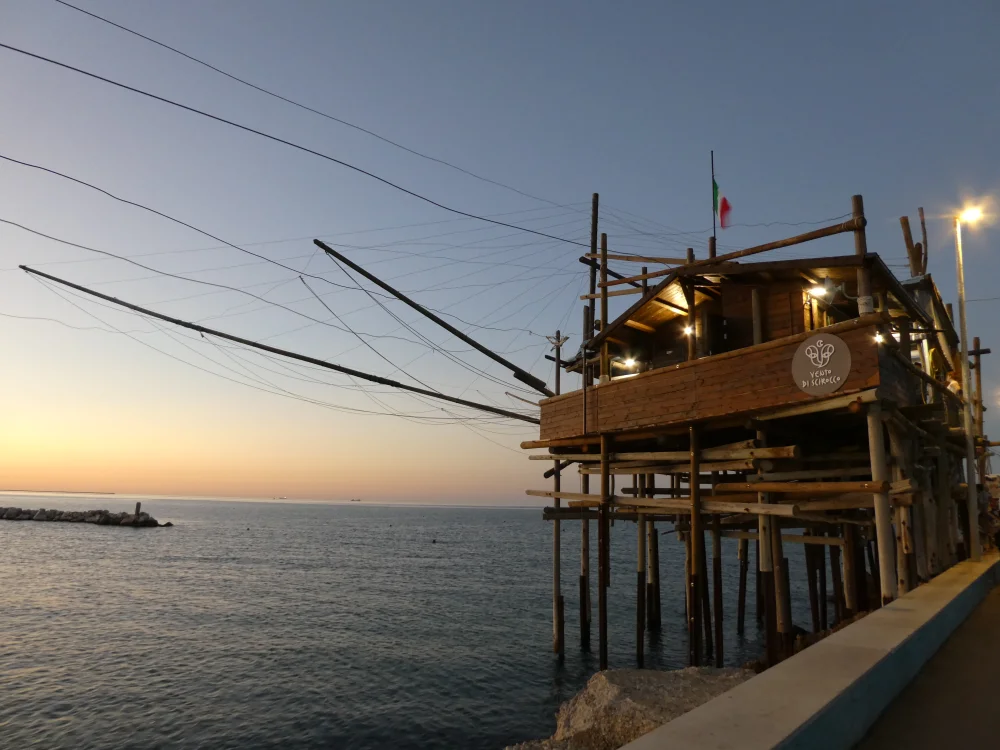
trabocco on Costa dei Trabocchi, San Vito Chietino. © Syrio / Wikimedia Commons · CC BY-SA 4.0
Leave Pescara heading south along the SS16. In 30 minutes, you reach San Vito Chietino, the official start of the Costa dei Trabocchi. Park near Eremo Dannunziano, the house where the writer stayed with Barbara Leoni in 1889.
Below, Trabocco Turchino extends into the sea. These fishing structures of acacia wood and rope resemble giant spiders resting on the water.
Eating on a trabocco in summer means booking months ahead. Punta Fornace or Punta Cavalluccio offer set menus from €60, along the SP119 or near Rocca San Giovanni. Without a booking, try the restaurants in San Vito Marina.
The acacia boards creak underfoot, and the waves vibrate through the supports. Meals often last more than two hours, with seafood starters, pasta, grilled fish and fried seafood.
In the afternoon, drive ten minutes inland to Abbazia di San Giovanni in Venere at Fossacesia. Admission is free, and its 12th-century marble doorway faces the sea.
Then descend to Vasto. A walk from 20 minutes on a dirt road leads to the promontory of the Riserva Naturale di Punta Aderci. In clear weather, the view includes Gran Sasso, Majella and Abruzzo National Park.
Finish the day in the historic centre of Vasto, built on a hill above the Gulf. Castello Caldoresco and Piazza Rossetti mark the heart of the city.
- 10:00Eremo Dannunziano and Trabocco TurchinoPark along the SS16.
- 13:00Lunch on a traboccoReservation required, fixed fish menu from 60 €.
- 16:00Abbazia di San Giovanni in VenereFossacesia, free entry.
- 18:00Riserva di Punta Aderci and Vasto centre20 minutes walk to the promontory.
Day 3 · Casacanditella · From the Riserva di Punta Aderci to the vineyards of Majella
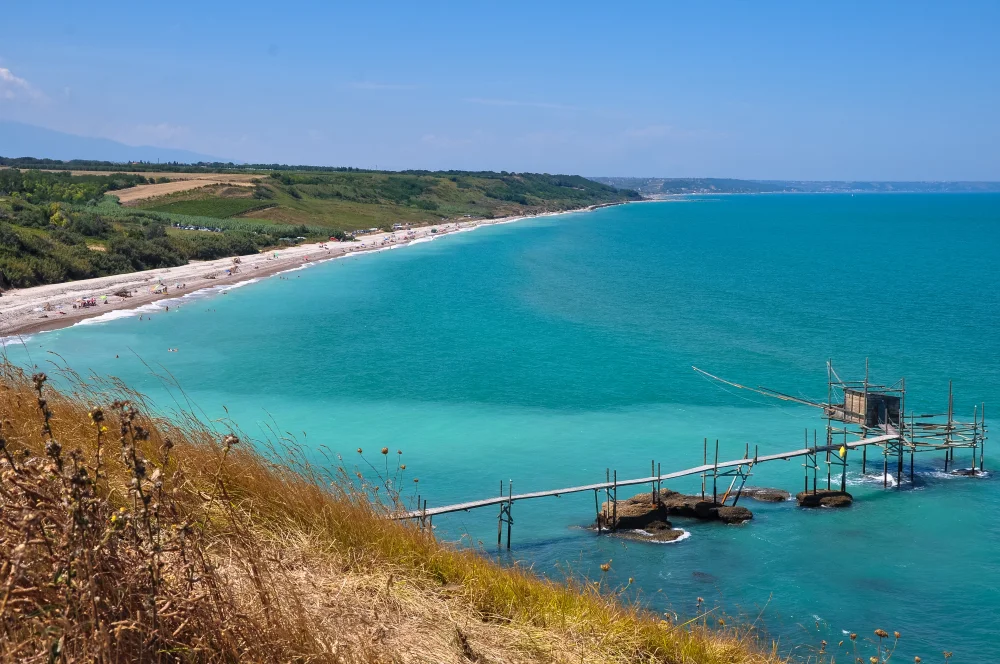
The Riserva Naturale di Punta Aderci, between Vasto and the Adriatic coast. © Goldmund100 / Wikimedia Commons · CC BY-SA 3.0
If the previous day's light was disappointing, return to Punta Aderci early. Anglers cast their lines from Motta's pebble beach, and the clear water reveals the seabed at depths of up to three metres .
Head inland towards the province of Chieti. Take the A14 north before turning onto the SS81 through vineyards and olive groves. It is around 40 km from the coast to Casacanditella.
Castello di Semivicoli rises above the village roofs. This 17th-century baronial palace was bought and restored in 2009 by Gianni Masciarelli, a long-established regional wine producer.
The building retains its wooden doors, stone press and fireplaces. Restoration introduced contemporary furniture and works from the Masciarelli Art Project.
An overnight stay includes access to the historic spaces. Arrange a tasting at reception: for 15 to 20 €, sample three estate wines, often Montepulciano d’Abruzzo Villa Gemma or Trebbiano Marina Cvetic, with local pecorino and cured meats.
Dinner is served in the former armoury or on the terrace facing Maiella.
- 10:00Riserva di Punta AderciMottagrossa beach.
- 15:00Road to CasacanditellaAbout 40 km from the coast.
- 18:00Wine tasting at Castello di SemivicoliThree wines from the Masciarelli estate.
Day 4 · Sulmona · Crossing Maiella to Sulmona
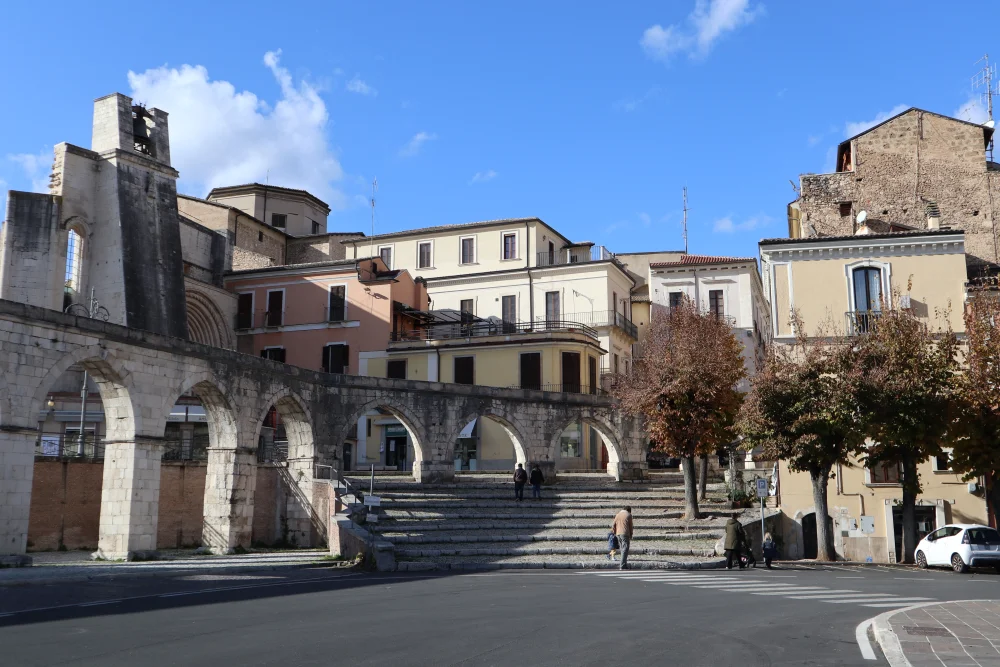
L'aqueduc médiéval de Sulmona, sur la Piazza Garibaldi. © Parsifall / Wikimedia Commons · CC BY-SA 4.0
The SP487 winds into Maiella National Park as white limestone replaces red earth. Cross Passo San Leonardo at 1,282 metres on a broad but winding road. Snow can close the pass between December and March; take the alternative route around the massif via the Aterno valley and A25.
Arrive in Sulmona in early afternoon. Park at Santa Chiara for €1.20 per hour, then walk up to Corso Ovidio.
Sulmona is the birthplace of the Roman poet Ovid, whose statue stands in Piazza XX Settembre. Its medieval aqueduct, built in 1256, has 21 pointed arches in dressed stone across Piazza Garibaldi.
Just behind, the Complesso della Santissima Annunziata mixes Gothic, Renaissance and Baroque facades.
For lunch, choose a central trattoria. Order maccheroni alla chitarra, square pasta cut on a wire-strung wooden frame, or pecora alla cottora, sheep meat slow-cooked in a copper pot with mountain herbs. Osteria del Tempo Perso or Taverna de li Caldora serve these specialities for around €20.
Sulmona is known for confetti: Avola almonds coated in layers of sugar, arranged as daisies or bunches of grapes in Corso Ovidio's shop windows.
Drive to Fabbrica Pelino, five minutes from the centre. The factory has made sugared almonds since 1783The museum on the first floor is free and exhibits old copper machines. Count €8 for a box of classics in the shop.
- 10:00Majella National ParkRoute SP487 via Passo San Leonardo.
- 13:30Lunch in the Peligna ValleyMaccheroni alla chitarra in the historic centre.
- 15:00Corso Ovidio and aqueductSulmona, historic center.
- 17:00Fabbrica PelinoFree museum on the first floor, purchase of sugared almonds.
Day 5 · Pescocostanzo · Pescocostanzo, one of the Borghi più belli d'Italia
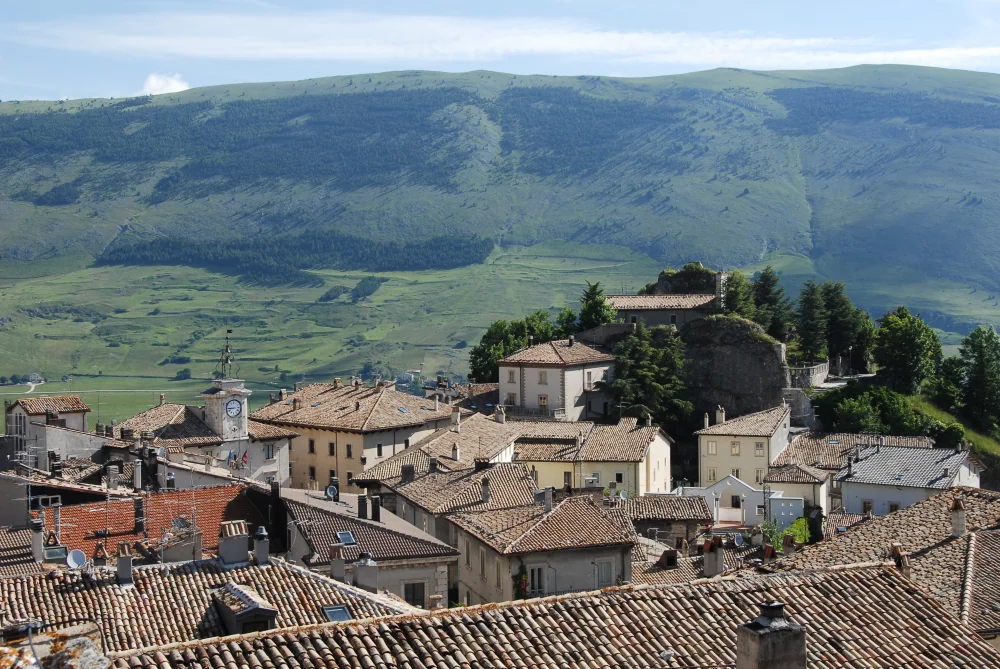
Le centre historique de Pescocostanzo, vu d'en haut. © Pattiolivieri / Wikimedia Commons · CC BY-SA 4.0
The SS17 Leave the Sulmona basin and climb onto the Altopiano delle Cinque Miglia, a windswept karst plateau where morning temperatures can fall below 15°C even in August. Allow forty minutes to reach Pescocostanzo at 1,395 metres Park at the entrance: the historic centre is completely pedestrian.
Pescocostanzo escaped earthquake damage and the property development of the 1970s, preserving its Renaissance and Baroque architecture.
Walk along Via del Colle. The wrought-iron balconies reflect a craft introduced by Lombard blacksmiths in the 15th century. Inside Santa Maria del Colle, look up at the carved and gilded wooden coffered ceiling.
Local craftspeople still make bobbin lace, displayed in windows along Via Vulpes.
In the afternoon, trails lead from nearby Rivisondoli or Bosco di Sant’Antonio towards Monte Acquaviva. A local guide leads a three-hour outing to look for Apennine chamois, reintroduced in 1991 and now numbering more than 700 individuals . Allow €20–30 for the outing. Sightings are frequent, but wildlife is never guaranteed.
- 10:00Route Sulmona to PescocostanzoCross the Altopiano delle Cinque Miglia.
- 11:30Historical centreWrought-iron balconies and Santa Maria del Colle.
- 14:30Guided outing in Maiella€20–30 with a guide, meeting at the trailhead.
Day 6 · Campo Imperatore · Santo Stefano di Sessanio · Campo Imperatore, Rocca Calascio and one night in a medieval village
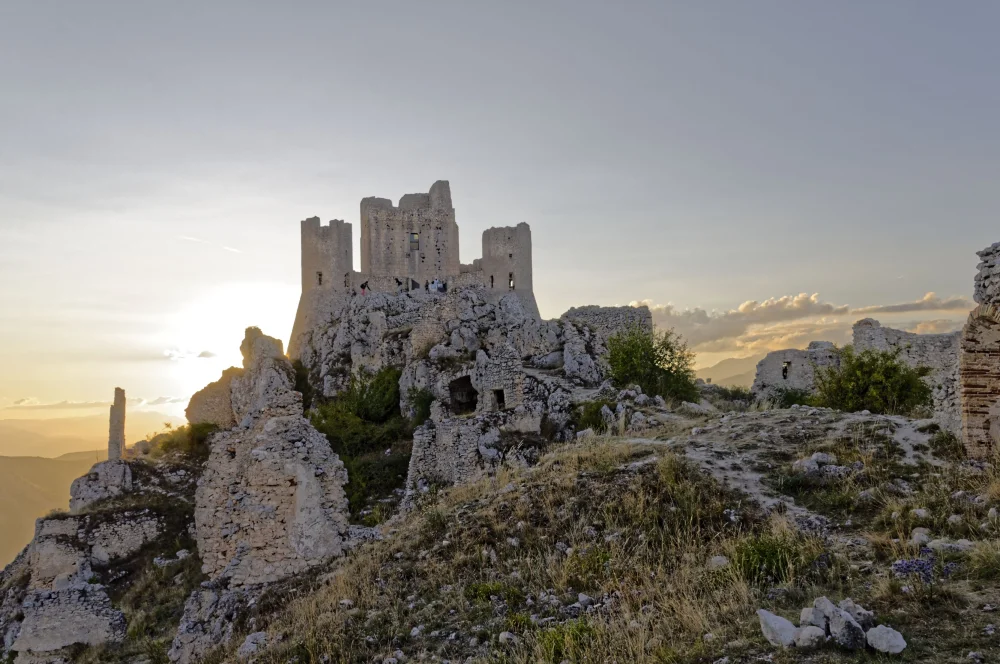
Rocca Calascio, la plus haute forteresse des Apennins. © Ra Boe / Wikimedia Commons · CC BY-SA 3.0 de
Head north. After an hour via Popoli, begin climbing towards Campo Imperatore on the SS17 bis. This high plateau, more than 1,600 metres above sea level in the Gran Sasso massif, is a windswept, treeless expanse.
Stop at Ristoro Mucciante in Fonte Vetica for arrosticini, Abruzzo's characteristic sheep-meat skewers. Grill them yourself on canaline, long, narrow barbecues shaped like gutters. Smoke stings the eyes, clings to wool jumpers and carries the smell of grilled meat across the car park.
Backtrack a little towards Rocca Calascio. Parking below the village is limited; in high season, a €2 shuttle departs from Calascio.
From the abandoned village, allow 45 minutes along a rocky path to reach the fortress. At 1,460 metres above sea level, the ruins overlook the Tirino Valley. Access is free. The cylindrical towers surrounding the square keep are associated with Ladyhawke, starring Michelle Pfeiffer, and The Name of the Rose.
At the end of the day, drive fifteen minutes to Santo Stefano di Sessanio. Entrepreneur Daniele Kihlgren bought a large part of the village's houses in the early 2000s to create Sextantio Albergo Diffuso: reception, restaurant and rooms are spread out in the historic buildings.
The cobbled lanes smell of wood smoke. Inside the rooms, switches are hidden, beds rest on sturdy trestles and handwoven wool blankets replace duvets.
Locanda Sotto gli Archi serves recipes documented by anthropologists, including mountain lentil soups and lamb with herbs. A full dinner costs around 50 €.
- 10:00Road via Campo ImperatoreSS17 bis, arrosticini stop at Fonte Vetica.
- 13:00Rocca Calascio45 minutes walk up, free entrance.
- 17:00Arrive in Santo Stefano di SessanioRooms scattered in the village.
- 20:00Dinner at Locanda Sotto gli ArchiHistorical recipes, 50 €.
Day 7 · L’Aquila · L’Aquila: the final stop before heading home
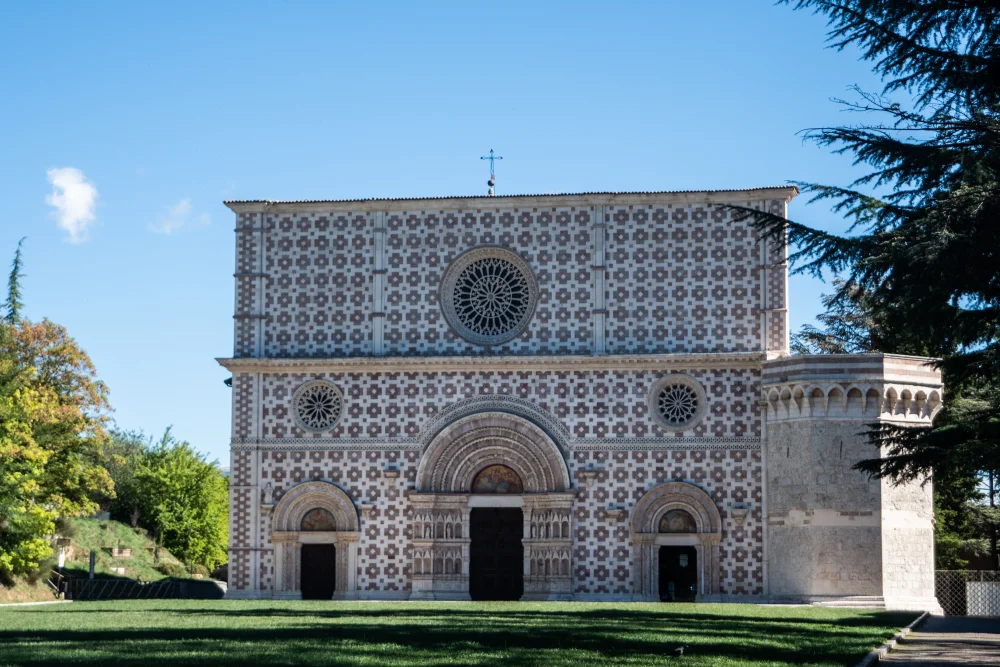
The facade of the Basilica of Santa Maria di Collemaggio, at L’Aquila. © Albrizio Iolanda / Wikimedia Commons · CC BY-SA 4.0
Leave Santo Stefano di Sessanio for a 40 minute journey to L’Aquila. Use the underground Collemaggio car park: the first two hours are free, then parking costs 2 € the day.
The centre still bears the marks of the 2009 earthquake. Cranes and scaffolding remain part of the landscape, but most major monuments have reopened.
The Basilica of Santa Maria di Collemaggio stands beside the car park. Its rectangular façade alternates white and pink stone, and the interior contains the tomb of Pope Celestine V. Each August, the side door opens for the Perdonanza, a tradition inscribed on UNESCO’s list of intangible cultural heritage.
Drive to Borgo Rivera to visit MUNDA, the National Museum of Abruzzo. Housed in the former slaughterhouse, it displays artworks rescued from churches damaged by the earthquake. Admission costs 5 €.
Afterwards, cross the street to the Fontana delle 99 Cannelle. Water flows from 99 carved stone masks along red-and-white chequered walls. Tradition connects the number with the castles involved in the city’s 13th-century foundation.
Have a porchetta panino at a central takeaway before the return drive. The A24 reaches Rome Fiumicino in 1 hour 30 minutes; for a flight from Pescara, the A25 takes you back in 1 hour 15 minutes.
- 10:00Basilica of CollemaggioFree parking 2 hours.
- 11:30MUNDA (ex-mattatoio)Borgo Rivera, museum €5.
- 13:00Fountain of the 99 SpoutsBorgo Rivera.
- 14:30Road back to the airportA24 for Rome, A25 for Pescara.
Planning this itinerary
Compare flights from your departure airport to Pescara (PSR) and Rome Fiumicino (FCO), allowing for the onward journey into Abruzzo. Routes vary by season: check your dates on Skyscanner before you book.
Alternatively, fly into Rome Fiumicino or Ciampino, hire a car and cross the peninsula via the A24. Rome to Pescara takes around two hours, with €18–20 in tolls.
- Book car hire ahead: category B or C is sufficient and easier to park in villages
- Book summer trabocco lunches several months before departure
- Bring a windproof jacket and jumper, even in August, for temperature changes at altitude
- Download an offline map: mobile reception is patchy in the mountains
Mountain roads such as the SS17 and SP487 require concentration: expect bends, frost-damaged asphalt in places and free-roaming livestock around Campo Imperatore.
May, June and September bring coastal temperatures of 20–25°C and around 15°C at altitude. In July and August, Italian holidaymakers fill the Adriatic coast, and accommodation prices in Vasto and Pescara can double.
The temperature difference between the Peligna Valley and Gran Sasso can be striking. You might be warm in a T-shirt on Piazza Garibaldi at 13:00, then face a cold wind at Rocca Calascio two hours later. Keep a jacket in the car.
Between Ortona and Vasto, three-century-old wooden fishing platforms have become some of Abruzzo’s most sought-after places for a seafood meal.
Read more →Climb from the stone village to the towers seen in Ladyhawke, passing narrow lanes, a small octagonal church and wide…
Read more →Frequently asked questions
Your guide to authentic travel in Italy
Find local places, detailed city guides, the best months to travel and practical tips for your trip to Italy on DolceRoutes.
Plan my trip on dolceroutes.com →