Cycling in Puglia: From the Itria Valley to the Salento
7 days among ancient olive trees, whitewashed villages and dramatic cliffs. A leisurely way to savour southern Italy at 15 km/h.
This cycling itinerary links Alberobello and the Itria Valley with Salento, finishing in Gallipoli and using regional train transfers. Leave the hire car behind and explore at the pace of a bicycle, with wild fennel in the air and an Adriatic breeze at your back.
The itinerary at a glance, day by day
- 1Alberobello · LocorotondoA trulli route through vineyards and dry-stone walls
- 2Locorotondo · OstuniBaroque Martina Franca and Cisternino's bombette
- 3Ostuni · LecceAncient olive trees and a natural swimming spot at Torre Guaceto
- 4Lecce · OtrantoAcaya, Roca Vecchia and the Adriatic cliffs
- 5Otranto · Santa Maria di LeucaThe SP358 coastal road to Finibus Terrae
- 6Leuca · GallipoliThe Maldives of the Salento and Baroque Nardò
- 7Gallipoli · ReturnGamberi rossi at the market and an FSE train to Lecce
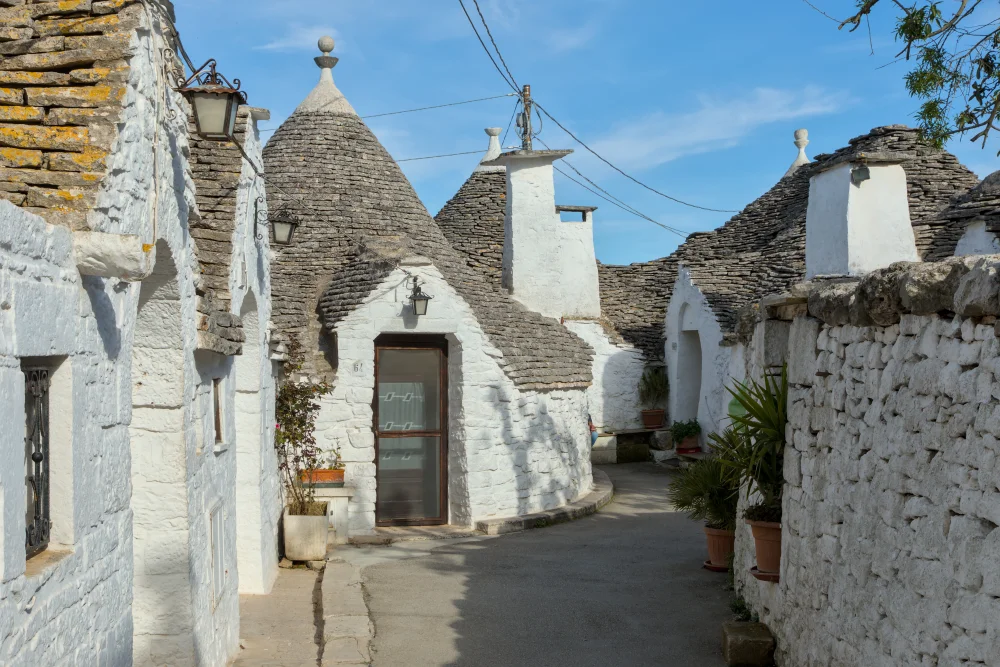
Day 1 · Alberobello — Alberobello to Locorotondo: cycling among the trulli
© Benjamin Smith / Wikimedia Commons — CC BY-SA 4.0
Your trip often begins at Bari Airport; remember to check timetables outside the season. Plan the rail connection carefully: there is no direct train from the terminal to the Itria Valley. Take the FM2 airport train to Bari Centrale first. From the main station, the small Ferrovie del Sud Est (FSE) trains head inland through farmland to Alberobello. The journey takes around 1 hour 45 minutes and marks the start of your Puglia cycling trip.
Local hire companies usually arrange bike delivery in Alberobello. As the monumental Rione Monti district fills with visitors, first push your bikes through quieter, still-inhabited Rione Aia Piccola before setting off. The route to Locorotondo is a gentle introduction, around 20 km with 150 metres of ascent. You ride through a landscape of dry-stone walls, neat vineyard rows and characteristic red earth.
Arriving in Locorotondo takes a little effort. The village sits on a circular hill, its whitewashed façades topped by cummerse, steep roofs covered in limestone slabs. In the late afternoon, sit at the Via Nardelli viewpoint with a glass of Locorotondo DOC, a dry, floral white made from the vineyards you have just ridden through.
- 3 pmCollect and adjust your bikes in AlberobelloSet the saddle height and check brakes and panniers with the hire company. Test the gears before leaving.
- 4.30 pmYour first kilometres through the contradeRide through rural hamlets on small local roads between vineyards and dry-stone walls. Traffic is almost non-existent.
- 7 pmTerrace aperitivo in LocorotondoTry local taralli with a panoramic valley view and a glass of Locorotondo DOC.
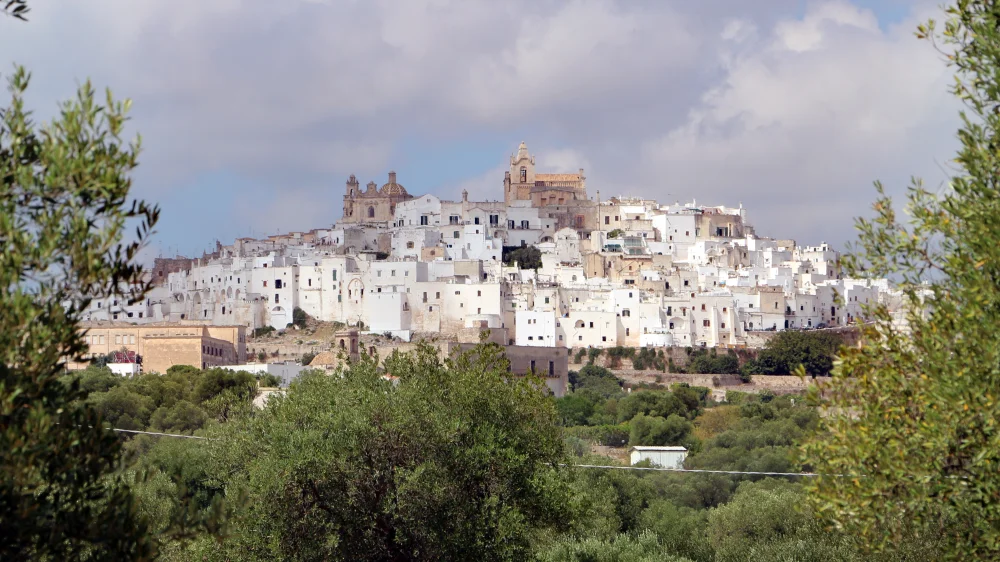
Day 2 · Locorotondo — Locorotondo to Ostuni: good food and views of the White City
© Sailko / Wikimedia Commons — CC BY 3.0
Today combines historic sights and generous food stops, over around 45 km with 280 metres of ascent. In the morning, head for Martina Franca, the Itria Valley's Baroque capital. Ride to Piazza Maria Immacolata and park your bikes for a coffee and a slice of capocollo. This local speciality is cured pork neck marinated in vincotto and lightly smoked with oak bark. Continue along a long stretch of the Ciclovia dell'Acquedotto Pugliese, a greenway following Europe's largest aqueduct.
By lunchtime, you reach Cisternino, where roast meat is taken very seriously at the fornelli pronti. Historic butchers operate as restaurants at midday. At Bère Vecchie, choose your meat at the counter, including bombette, pork rolls stuffed with canestrato cheese and parsley. It is cooked in a wood-fired oven and served on butcher's paper: hearty fuel for the ride ahead. The afternoon approach to Ostuni is a highlight. A bend on the SP22 suddenly reveals the fortified whitewashed town on its rocky spur. Use your lowest gears for the final climb up Via Pola. At the top, the view from the walls rewards every pedal stroke.
- 10 amBaroque architecture in Martina FrancaThe Ducal Palace and capocollo on Piazza Maria Immacolata. Try the local cured meat with a coffee.
- 11.30 amCiclovia dell'Acquedotto PuglieseSafe riding on a greenway away from cars, with stone bridges and views down towards scattered trulli.
- 1.30 pmLunch at a Cisternino butcher'sOrder bombette at a fornello pronto. Easily the most filling food stop on the route.
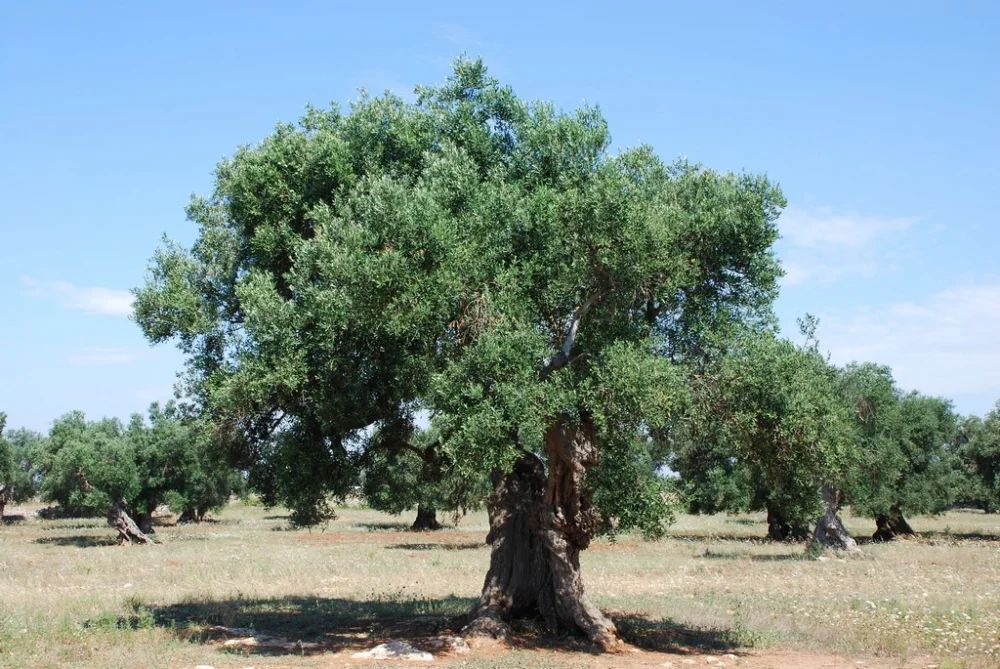
Day 3 · Ostuni — Ostuni to Lecce: olive groves and Torre Guaceto nature reserve
© Yellow.Cat from Roma, Italy / Wikimedia Commons — CC BY 2.0
Enjoy the freewheeling descent from Ostuni to the coastal plain. You enter the Piana degli Ulivi Secolari, the plain of ancient olive trees. For almost 20 km, you ride through a natural museum: some of these gnarled, hollow-trunked trees already stood here in Roman times, beside the old Via Traiana. Stop at Masseria Brancati, booking the visit directly through its website. The owner guides you through the monumental olive grove before a tasting of aromatic extra-virgin oils pressed in the underground mill dating from Messapian times.
The route then heads for the coast on small provincial roads such as the SP20, making around 50 km today on downhill and level terrain. You reach Torre Guaceto nature reserve, where motor vehicles are prohibited, making it ideal for cycling. Follow compacted-earth paths between lagoons and the sea, then leave the bikes for a long swim in the clear Adriatic. After drying in the sun, ride to Brindisi station, 15 km away. Here the rail connection earns its place: buy a regional train ticket and a Trenitalia bike supplement, valid for 24 hours and costing around €3.50. Thirty minutes in air-conditioned comfort brings you into central Lecce.
- 9.30 amThe descent from OstuniRide towards the farmland with the wind in your face. The surface is excellent and the slope does the work.
- 11 amMasseria BrancatiTaste extra-virgin olive oil beneath 2,500-year-old trees. Booking directly through the website is recommended.
- 1.30 pmTorre Guaceto nature reserveA picnic and swim in clear Adriatic water away from the crowds. One of the route's best stops.
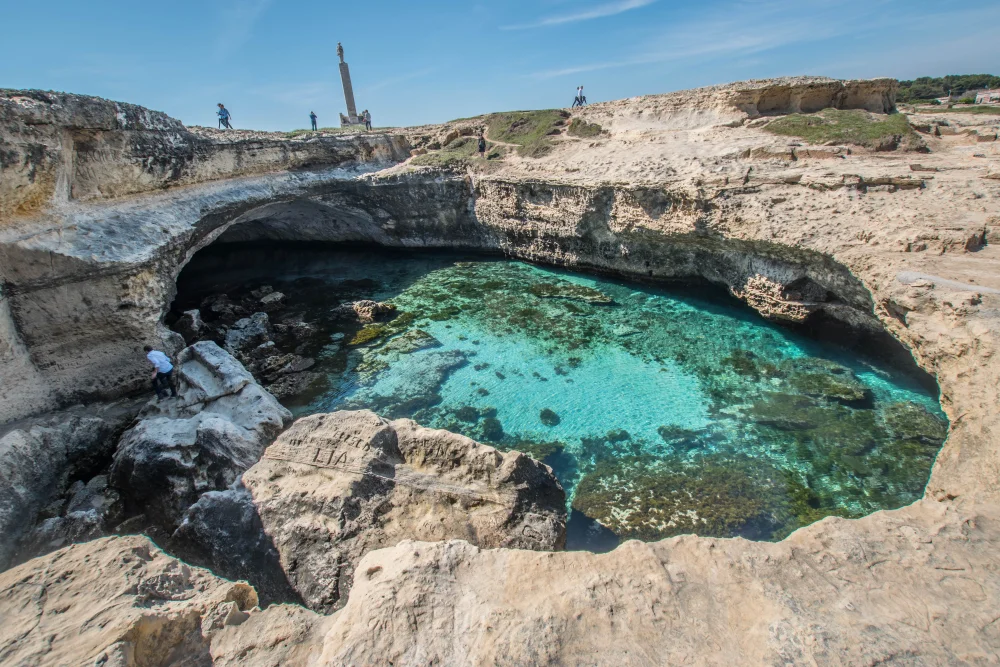
Day 4 · Lecce — Lecce to Otranto: Baroque sights and Adriatic cliffs
© andresumida / Wikimedia Commons — CC BY 2.0
Begin the morning in Lecce with a pasticciotto, a crisp, lard-based shortcrust pastry filled with custard and served warm, and a caffè leccese, an espresso poured over ice with almond syrup at the bottom. You will need the energy for today's 55 km, with little climbing at around 150 metres. Leave Lecce eastwards on small farm roads lined with agaves, heading to Acaya. This is a well-preserved example of Renaissance military architecture, surrounded by dry moats.
From Le Cesine nature reserve, you follow the SP366 with the Adriatic on your left. The steady sea breeze makes the effort pleasant. As the landscape turns rocky, stop at Grotta della Poesia in Roca Vecchia, a natural pool hollowed out of the limestone plateau. A few kilometres further on, Sant'Andrea's sea stacks face the easterly waves. The road then crosses the coastal pine woods around the Alimini lakes, where warm pine resin scents mingle with the sea air. Otranto appears behind its thick Aragonese walls towards evening. Make time for the cathedral floor: an enormous 12th-century mosaic depicting an elaborate Tree of Life.
- 9 amBreakfast in LeccePasticciotto and caffè leccese at Alvino on Piazza Sant'Oronzo, a local pastry shop since 1860.
- 10.30 amAcaya's Renaissance castleA short architectural stop beside the dry moats. One of southern Italy's best-preserved examples.
- 12.30 pmSant'Andrea cliffs and Grotta della PoesiaA light puccia lunch beside the rock arches, then a stop to admire the natural pools. Swimming is prohibited at Grotta della Poesia; follow the site's access rules and signs.
Day 5 · Otranto — Otranto to Leuca: the challenge of the SP358 coastal road
© Stiflele / Wikimedia Commons — CC BY-SA 4.0
This is the queen stage and the trip's big challenge. On a conventional bike, your quadriceps will work hard. On an e-bike, keep an eye on the battery level. The route from Otranto to Santa Maria di Leuca is approximately 55 km and follows the SP358 provincial road throughout. Depending on your detours, it adds up to 600–800 metres of climbing: a succession of sharp climbs, sometimes at 8%, and steep descents cut into the cliffs. The road surface is excellent, however, making for a smooth ride. Just south of Otranto, you pass the Punta Palascia headland, Italy's easternmost point. In clear weather, Albania's mountains line the horizon.
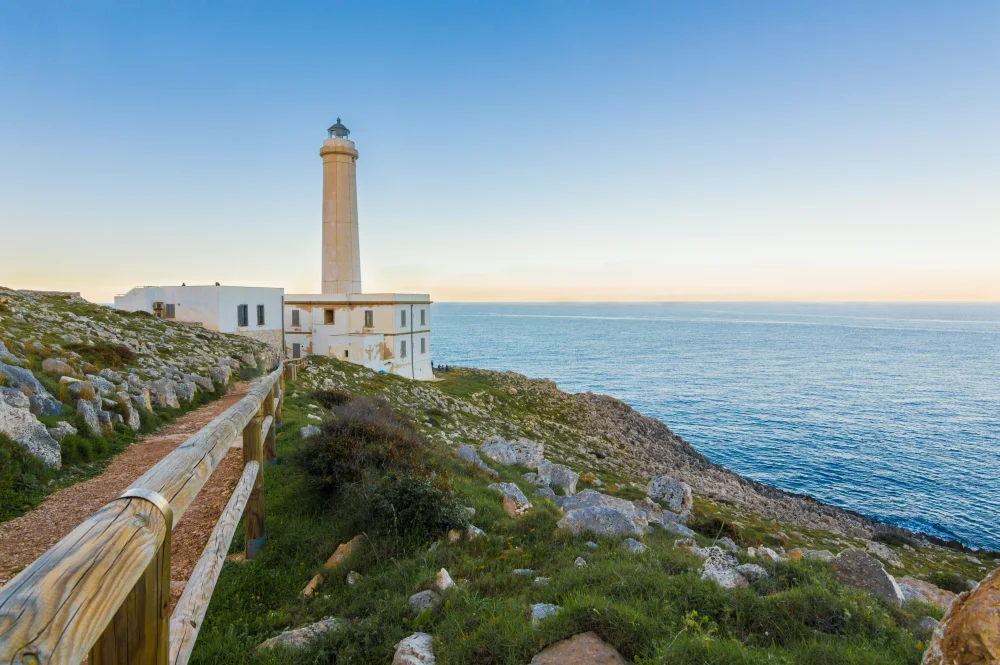
The riding is demanding, with strong sun often beating down on bare rock, but each bend opens a view over inky-blue water. Take a restorative break at Porto Badisco, a narrow, fjord-like cove. Further on, you pass the spa resort of Santa Cesarea Terme, recognisable by its striking Moorish-style villas perched above the drop. Near the end, you cross the Ciolo bridge above a deep cove where young people dive from the cliffs. Reaching Santa Maria di Leuca and its large white lighthouse at Finibus Terrae, the end of the land, is immensely satisfying. Here the Ionian meets the Adriatic.
- 9 amLeaving OtrantoFill your water bottles carefully before tackling the coastal road. Every village fountain matters on this stage.
- 11 amA break at Porto BadiscoThe fjord-like cove is ideal for catching your breath. Swimming is possible in its sheltered water.
- 1.30 pmLunch in Castro MarinaGrilled fish overlooking the sea at a small harbour restaurant. Good fuel for the final kilometres.
Day 6 · Santa Maria di Leuca — Leuca to Gallipoli: Ionian beaches and an optional visit to Nardò
© Andrea / Wikimedia Commons — CC BY-SA 3.0 it
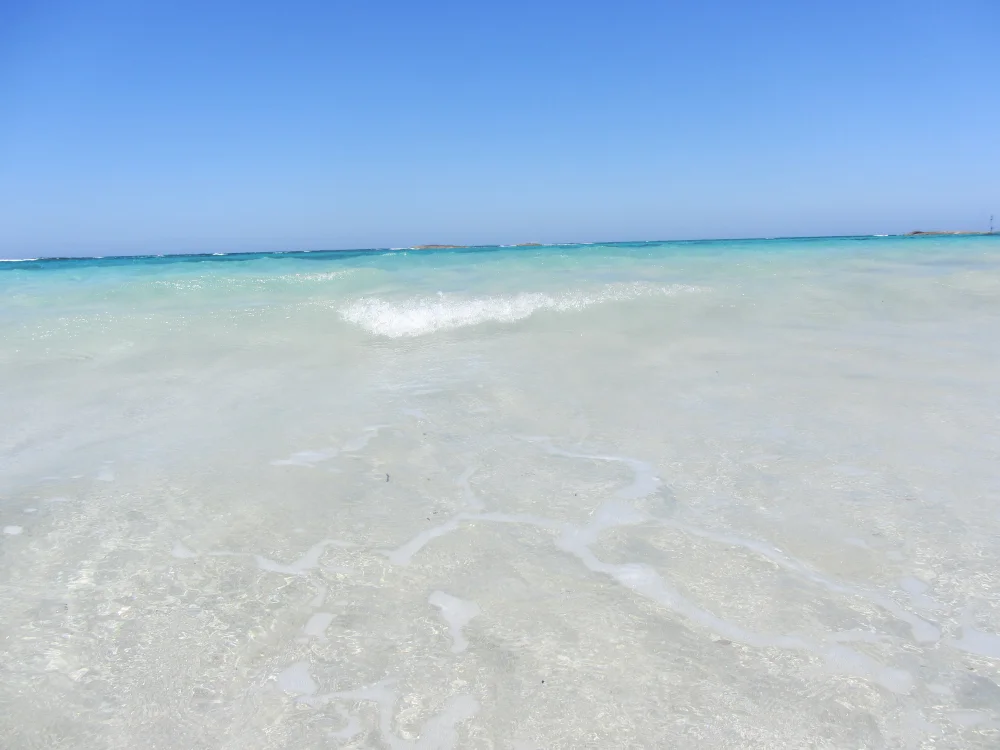
After yesterday's challenge, the terrain levels out. Heading north along the Salento's western side, facing the Ionian, cliffs give way to a low-lying coast. This is an active recovery stage of around 50 km, following broad stretches of fine sand. You pass Marina di Pescoluse, often nicknamed the "Maldives of the Salento". In May or September, riding between turquoise water and dunes covered in sea daffodils is a pleasure. Near Gallipoli, Punta Pizzo reserve offers a beautiful stretch in the shade of dense Aleppo pine woods.
For e-bike riders or anyone with energy left, an early arrival in Gallipoli leaves room for a worthwhile detour. Drop your panniers at the hotel, then ride a 30 km loop to Nardò without luggage. This inland town is too often overlooked. Away from the summer crowds, it has one of Italy's most theatrical Baroque squares, Piazza Salandra. Stop for a puccia on a terrace before heading back down to Gallipoli. In the evening, the island old town lights up, and sunset over Purità beach below the walls is a highlight of the trip.
- 10 amPescoluse beachesA morning ride beside the "Maldives of the Salento". The shallow turquoise water makes a swim hard to resist.
- 1 pmLunch in Torre San GiovanniFritto misto at a beach shack on the sand. Order cozze gratinate, the local baked mussels, too.
- 3.30 pmNardò detour (optional)A 30 km return loop without luggage to see Baroque Piazza Salandra, one of southern Italy's finest squares.
Day 7 · Gallipoli — Explore Gallipoli, then return to Lecce by train
© Carlo Pelagalli / Wikimedia Commons — CC BY-SA 3.0
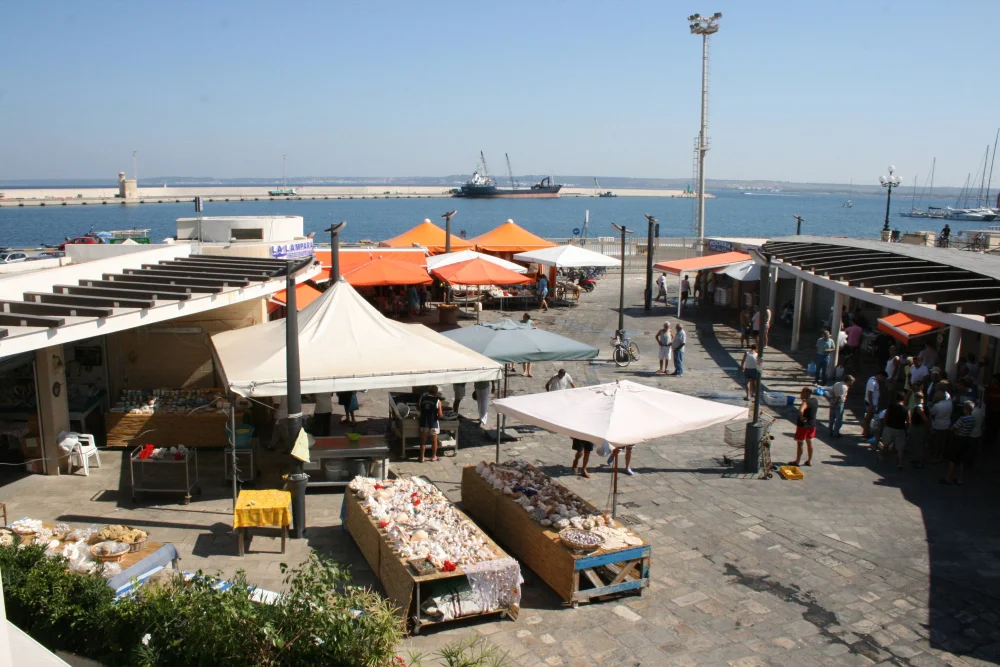
Leave the alarm off. This last day is for local life and the journey back. From 8 am, the fish market below Gallipoli Castle is in full swing: noisy, down-to-earth, with fishermen cleaning nets and negotiating prices. Sit at a simple table and order gamberi rossi, Gallipoli's red prawns. They are eaten raw, heads removed, with a drop of lemon. Then look for a vacuum-packed jar of scapece gallipolina in the old-town lanes. This medieval recipe preserved fish during sieges using breadcrumbs, vinegar and saffron, which gives it a striking bright-yellow colour.
It is time to finish the cycling. A good hire company will collect the bikes directly from your hotel. To reach Lecce or an airport, head to Gallipoli's small station. Regional FSE trains link Gallipoli with Lecce on branch lines, taking around 1 hour 20 minutes to 1 hour 45 minutes. Allow a generous margin for a high-speed Frecce connection in Lecce or a flight from Bari.
- 8.30 amGallipoli fish marketTry raw gamberi rossi and sea urchins below the castle, a classic local ritual.
- 11 amFood shoppingOlive oil, Primitivo wine and scapece gallipolina from grocers in the old-town lanes.
- 2 pmThe train backTake an FSE service to Lecce. Allow 1 hour 20 minutes to 1 hour 45 minutes, with plenty of time for connections.
Planning this cycling route
You can ride this route on a trekking bike or an e-bike. Puglia's network of minor roads is of excellent quality, and local drivers are considerate towards touring cyclists. You do not need top-level sports equipment, but a few essentials make a big difference to comfort over several days.
Recommended cycling equipment
| Equipment | Why it matters |
|---|---|
| Cycling shorts with a gel pad | A hire-bike saddle will never be moulded to your shape. Padded shorts are your best protection against sore sit bones after the third day. Do not set off without them. |
| Fingerless cycling gloves | Fingerless gloves absorb road vibrations and ease pressure on your palms, especially on the paved streets of Lecce's and Otranto's historic centres. |
| Reinforced puncture-resistant tyres | Check that your hire company's bikes have reinforced tyres such as Schwalbe Marathon. Bramble thorns and debris from maritime pines can be troublesome on Salento tracks. |
| Wraparound sunglasses | Essential for UV protection and for keeping out insects and dust carried by the sea wind on exposed coastal stages. |
- Book your bike as early as possible with a reputable local company, such as Puglia Cycle Tours or Apulia Bike Tours, with delivery in Alberobello and collection in Gallipoli.
- Arrange your hire company's luggage-transfer service: a driver collects your suitcase in the morning and delivers it to your next stop, leaving you to ride light.
- Most hire companies supply a GPX route. Download it into Komoot or RideWithGPS to stay on small farm roads and avoid dangerous main roads.
- Buy a train ticket with a Trenitalia bicycle supplement, around €3.50 and valid for 24 hours, for Brindisi–Lecce on Day 3 and Gallipoli–Lecce on Day 7.
In southern Puglia, the wind sets the pace. Fishermen and farmers check it daily. Before starting the coastal stages, look at the local forecast. A scirocco, the warm wind from Africa, will be behind you as you ride north along the Ionian coast on Day 6. If a cool northerly tramontana is forecast, it will push you from Otranto towards Leuca's lighthouse. Understanding the wind direction makes a real difference to a Salento cycling day.
Avoid 15 July to 31 August. Road temperatures approach 40°C, the coastal roads become long and hazardous traffic queues, and prices double. The ideal windows are mid-April to late May and mid-September to late October.
Five days in Puglia: from Bari's alleyways to Lecce's Baroque, via the red earth of the Itria Valley.
Read more →Explore Italy's heel by train and bus: routes, itineraries and practical advice for a slower trip.
Read more →Frequently asked questions
Your guide to authentic travel in Italy
Find local places, detailed city guides, the best months to travel and practical tips for your trip to Italy on DolceRoutes.
Plan my trip on dolceroutes.com →